
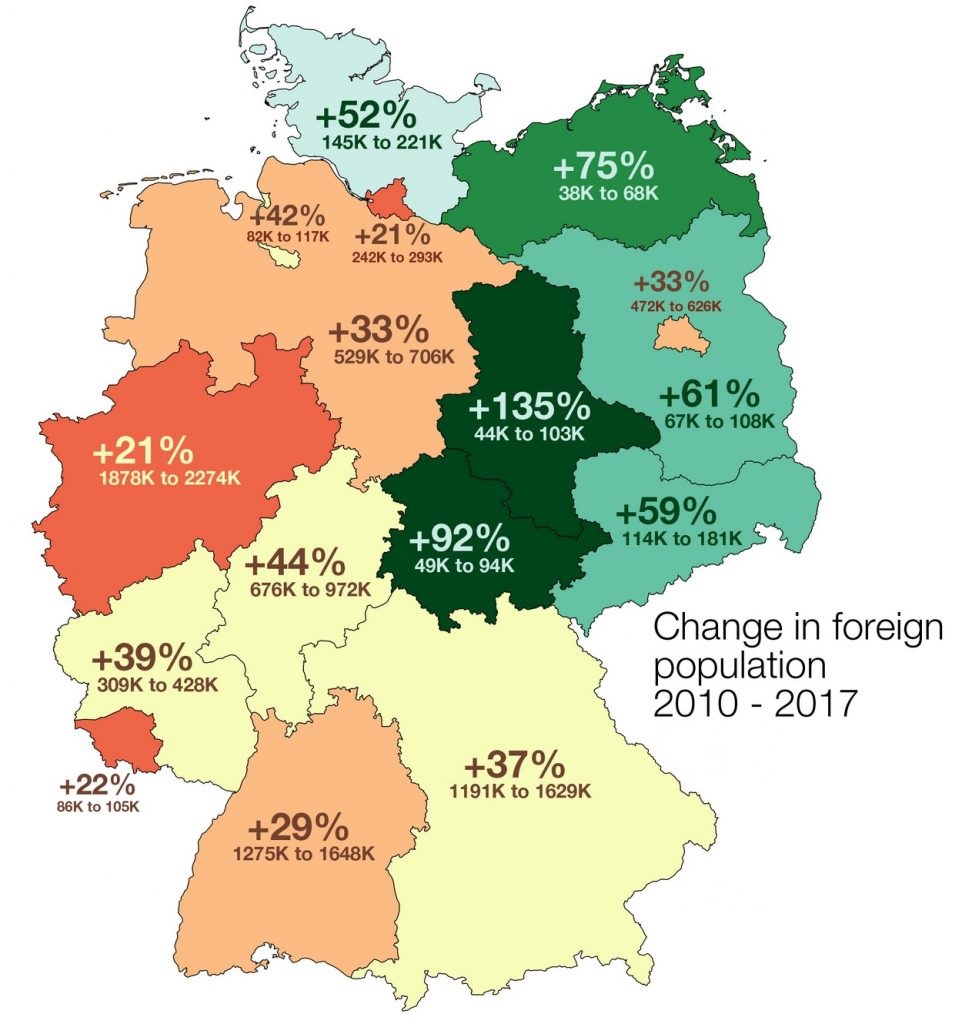
Immigration, in great growth in Germany, especially in the Eastern landers, where in some cases there is a doubling and so far very few foreigners lived. Immigration, how foreigners have increased in Germany Germany is one of the countries where the percentage and number of immigrants has grown most in recent years. Not only because of the opening granted by Angela Merkel to Syrian refugees in 2015. But also because of a continuous flow coming in particular from the Balkans first, from Asia afterwards, and partly from Africa, via Italy, throughout the decade. The result is that at the end of 2017 there were 12 million 165 thousand foreigners in Germany, corresponding to 14.8% of the population. It is a very high percentage, among the largest in Europe. In Italy, for example, it is about 9%. Of course, after Turkey, in first place with about 1.5 million foreigners, there are also countries like Poland, in second position, and Italy, in fourth position. The Syrians, however, are third, with 700 thousand inhabitants. After the Italians there are Romanians, Croats, Greeks, Bulgarians, always Europeans then. In ninth place are the Afghans with 251 thousand immigrants. This according to the German Statistical Office. Immigration, doubled the number of foreigners in some areas of the East. Even more interesting is the distribution of the presence of immigrants. There are many more in the West, for example in the Rhineland, 2.247 million, in Bavaria, 1.629 million, as in Baden Wurttemberg. But they grow more where they originally were less, in the East. There is like a redistribution of foreigners, in which a role was played by the guided arrival of the Syrians in recent years. In fact in the Rhineland the growth of immigrants was 21%, much, much lower than the average of other German landers. In Saxony Anhalt, in the East, by 135%. There has been more than a doubling. Which was easy since it started at 44,000. But still worthy of note. There was also a +92% in Thuringia, where, however, there were only 94 thousand immigrants. A +61% in Brandenburg, a +75% in Mecklenburg-Pomerania, where only 68 thousand remain. In Germany there was, and in a sense there still is, a huge distance between East and West. Greater than the distance between North and South in Italy. But apparently it's bound to fill up.



![Arcadia [NG]](/data/avatars/s/2/2320.jpg?1720432497)