

Introduction
Isopsephy is the ancient Greek practice of assigning numerical values to letters, allowing words and names to be compared through their total numerical value. The word Isopsephy comes from the Ancient Greek isopsēphía (ἰσοψηφία), formed from isos (ἴσος), meaning "equal," and psēphos (ψῆφος), meaning "number," "calculation," or "counting stone." Together, the name means "equal numerical value," reflecting the practice of revealing hidden relationships between words and names through their shared numerical totals.
This system has long been used in mystical and philosophical traditions to explore symbolic and esoteric patterns within language. It was studied by the Ancient Egyptian Priesthood, the Pythagorean Order, the Platonic Academy, and many more Mystery Schools of the Gods, where number was regarded as a key to understanding the hidden order of the universe and the divine, revealing connections that were otherwise unknown and unseen.
These Ancient Orders of the Gods knew that behind letters lay numbers, and behind the numbers lay sacred geometry, and behind the geometry lay the sound frequencies from which form first emerged.
There are many ways to uncover connections through Isopsephy. These methods offer a framework for examining recurring themes and hidden connections among Gods, myths, and esoteric concepts across cultures and across time itself.
In this guide, I will demonstrate a few methods of making meaningful connections using a variety of ciphers, illustrating how different numerical systems can reveal recurring patterns, correspondences, and esoteric links between names, Gods, and spiritual concepts.
Ciphers (Alphanumeric Systems)
The ciphers I will mainly be using for this are Pythagorean Reduction, Reverse Pythagorean Reduction, Greek Ordinal and Greek Pythagorean Reduction, English Ordinal, and Reverse English Ordinal, each revealing a different numerical perspective on language.
Pythagorean Reduction assigns the repeating values 1–9 to the alphabet.
Reverse Reduction likewise reverses the alphabet while retaining the repeating 1–9 cycle.


Greek Ordinal preserves the traditional Greek alphabetic sequence by assigning each letter its position in the Greek alphabet (1–27),
Greek Reduction preserves the Greek alphabet while reducing each letter's ordinal value to a single-digit cycle (1–9),
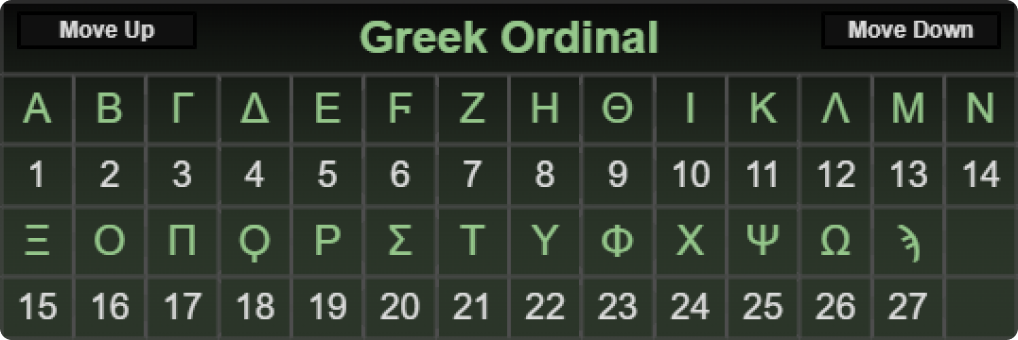

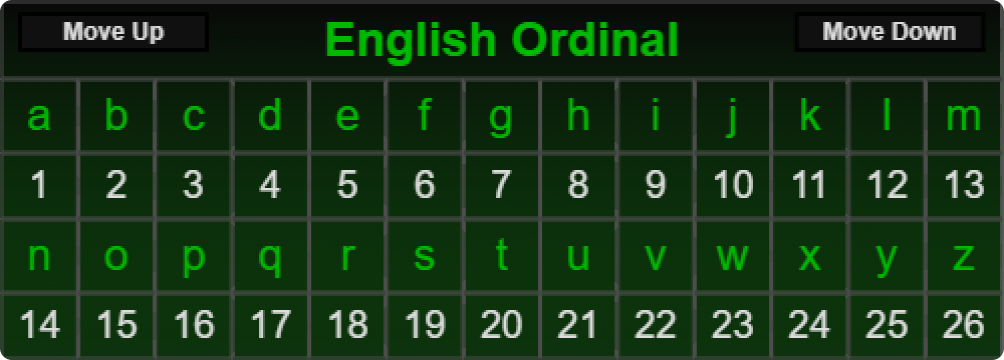
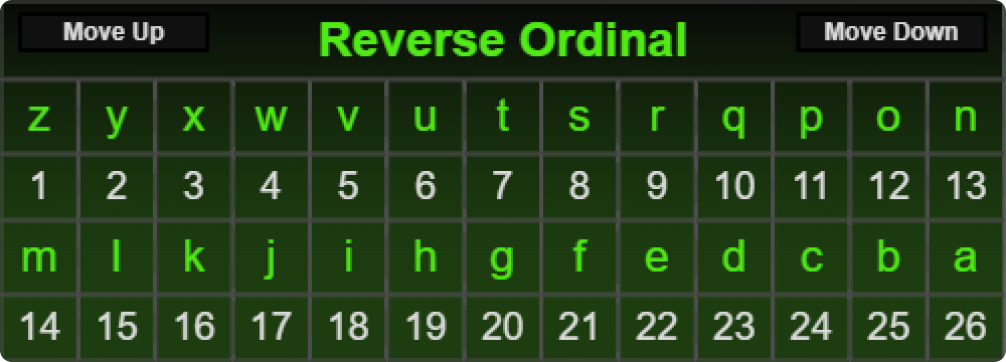
The Ordinal cipher follows the natural order of the English alphabet (A = 1 through Z = 26). Reverse Ordinal mirrors these values in reverse (Z = 1 through A = 26).
By examining names and words through several ciphers rather than relying on a single system, recurring numerical harmonies and symbolic correspondences become more apparent, offering multiple lenses through which hidden patterns and spiritual relationships may be explored.
Connections Between the Names of Zefs
There's no better way to start off the connections we can make in Isopsephy than by exploring the connections of the different names of our Head God himself, Lord Zeus. Here, I will show a series of numbers that connect the different names of the God of Gods.
The further analysis and study of the numbers and WHY they are important to God will not be discussed in this post; that is for another post. These will be very simple connections, just to demonstrate how basic Isopsephy works.
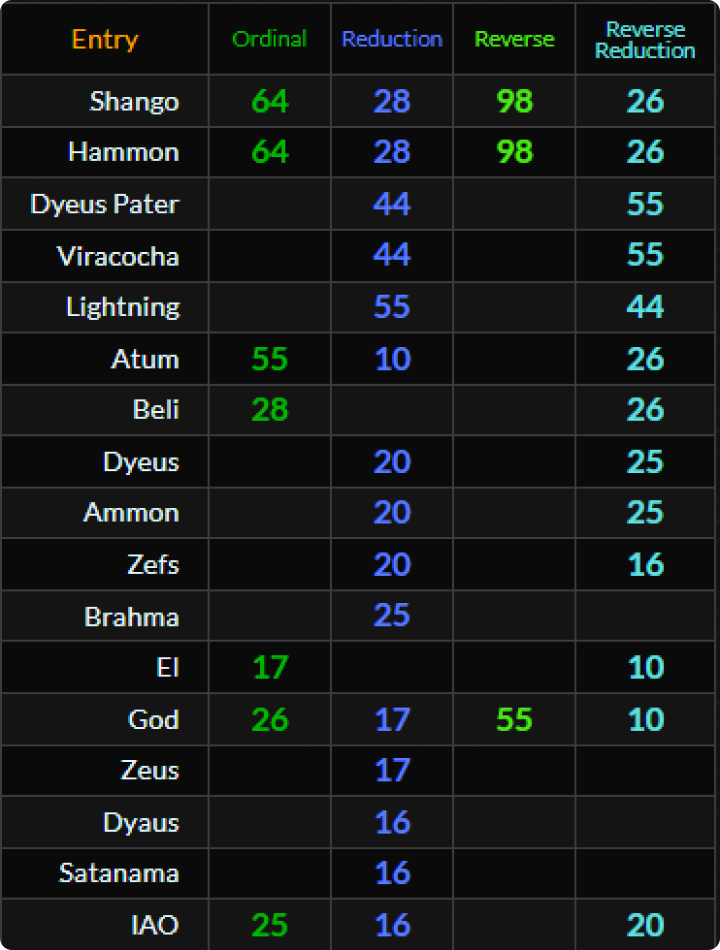
Several entries of names relating to God Zeus from completely different unrelated cultures form clear numerical relationships across the four Isopsephy ciphers.
Rather than random values, the same core numbers: 10, 16, 17, 20, 25, 26, 28, 44, 55, 64, and 98, cycle, mirror, and transpose through different ciphers, forming a single interconnected numerical pattern.
There are many, many more names I could have included that connect to the same numbers, but I wanted to leave some room for others to investigate these further themselves.
While not a name of Zeus, I thought it was interesting that the Temple of Zeus, also equals 55, connecting to Zeus directly through his names: Atum, Viracocha, Dyeus Pater, and God.

Sirius Secrets
Sirius the Dog Star, the brightest star in the sky, has always been associated with enlightenment and was venerated by almost every culture of the Gods.
This sacred star has very interesting Isopsephy that reveals some of its secrets, and there’s no better time than now for me to show you, as the Sun is now Conjunct Sirius.
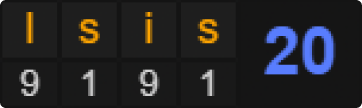
In Ancient Egypt, the great Goddess Isis was associated with Sirius.
In English Pythagorean Reduction Isis has a value of 20
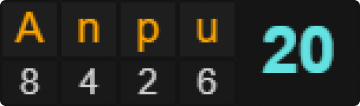
Anubis, the God depicted with the head of a Dog, and related to dogs and to Sirius the Dog Star, is also called Anpu.
In English Reverse Reduction the name Anpu has the value of 20.
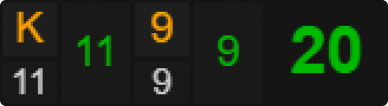
K9 (or K-9) is a phonetic abbreviation of the word canine, which refers to dogs.
In English Ordinal K9 has a value of 20.
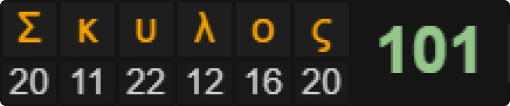
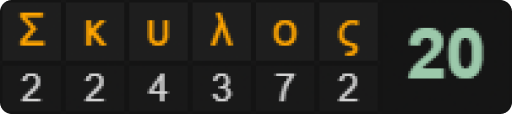
In Greek, skylos (σκύλος) is the standard word for Dog. Sirius is the Dog Star.
In Greek Ordinal skylos (σκύλος) has the value of 101.
In Greek Pythagorean Reduction skylos (σκύλος), has the value of 20.
In English Ordinal, skylos has the same value of 101.
In English Pythagorean Reduction skylos has the same value of 20.
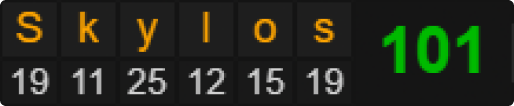
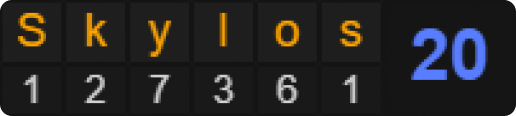
Between multiple different languages and alphabets that developed through separate histories, this numerical alignment reveals a profound hidden connection of numbers, where the same word preserves the same numerical pattern across different systems, even though Greek and English are distinct alphabets from different linguistic traditions.
The number 20 is significant here because it alludes to the traditional “Dog Days of Summer.” which we have just entered. In ancient Greek and Roman astronomy, the heliacal rising of Sirius “the Dog Star”, its first visible appearance just before sunrise after a period of invisibility, coincided with the hottest part of the summer. This period was traditionally understood to last approximately 20 days, during which the combined presence of the Sun and Sirius was believed to intensify the season's heat.
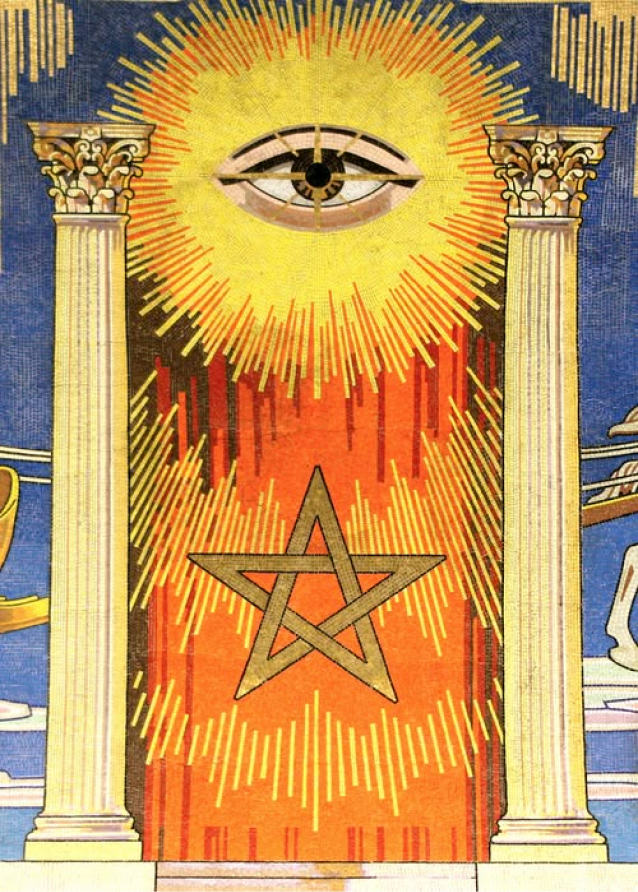
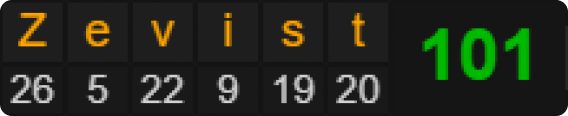
The number 101 is significant because it represents the two pillars of the soul with the all-seeing third eye (represented by Sirius) in the middle of them. 1-0-1
Strikingly, Zevist also equals 101 in English Ordinal, remember to keep your Third Eye open Zevists!
Now I will show you another interesting thing regarding Sirius.
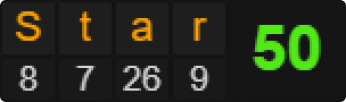
Since this centers on a Sacred Star, it is noteworthy that, in English Reverse Ordinal, "Star" carries a value of 50.
In English Pythagorean Reduction, the word Canis Majoris, which is the name of the constellation that houses Sirius, has a value of 50

In English Reverse Reduction, the word Seirios, the transliterated Greek word for Σείριος (the Ancient Greek name of Sirius and where the name Sirius comes from) has a value of 50

In English Reverse Reduction, Dog’s Star (Sirius is known as the Dog’s Star, note the connection to Anubis here) also has a value of 50.

Sirius, the brightest star in the night sky, is actually not a single star but a binary star system made of two stars: Sirius A, a bright main-sequence star, and Sirius B, a faint white dwarf companion. Together they orbit each other about every 50 years, with their distance changing as they move through space.
This is the reason the number 50 here is so significant, and the numerical connection between languages reinforces this significance.
The Pi Code
Pi (Π, π) is a very sacred Greek letter and number and is the numerical representation of infinity itself. It was a number that connected the finite and the infinite.
The perfect circle embodies the Monad, unity, harmony, and eternity, while Pi, whose digits unfold endlessly without repetition or end, reveals that even the simplest form contains an endless mystery.
Pi is the eternal bridge between the visible and the invisible, the measurable and the immeasurable. It proves that the universe the Gods made is built upon an infinite divine order expressed through number.
The ancient approximation 22/7 has long served as a expression of π, representing humanity's attempt to grasp the infinite through the finite. The reason being is because 22/7 = 3.14 the digits of π.
Astonishingly, When you type out the equation “Twenty Two divided by Seven,” in English Ordinal, It has a value of 314 the digits of Pi π.

Finale
Today, I have shared a few of the many ways that Isopsephy can reveal hidden connections. There are countless more to explore, for an infinite universe offers endless patterns waiting to be discovered. These findings are anything but coincidence. They reveal the sacred science through which the Gods communicate through number.
I encourage all of you to try this on your own. You can enter your name and birth date into the different numerological systems and explore the patterns that emerge, and how they may symbolically relate to our Gods, your Guardian Daimon, and major events in your life.
In doing so, you may begin to see how numbers can act as a bridge between language, meaning, and personal experience.
I hope you all enjoyed this and found it meaningful and insightful.
HAIL THOTH!
HAIL OSIRIS!
HAIL ZEFS!!!