Alexander666
Member
- Joined
- Apr 23, 2022
- Messages
- 360
Thank you, SG, for your professional articles about our beloved Gods. Everyone should read them to deprogram from Abrahamic narratives and connect more deeply with our deities.



Book 1, History of Rome, LivyWhen he had thus obtained the kingship, he prepared to give the new City, founded by force of arms, a new foundation in law, statutes, and observances. And perceiving that men could not grow used to these things in the midst of wars, since their natures grew wild and savage through warfare, he thought it needful that his warlike people should be softened by the disuse of arms, and built the temple of Janus at the bottom of the Argiletum, as an index of peace and war, that when open it might signify that the nation was in arms, when closed that all the peoples round about were pacified.
“Omne principium Iano” — Every beginning belongs to Janus.
The mystery of Janus since the time of Ancient Rome was one of the most important celebrations of Rome. As time elapsed, the knowledge of the Great God started being buried beneath the rubble as the people stopped remembering him, despite of his name being the name of the month IAN-UARY or January, the first month of the year of the Calendar.
The first three letters of Janus’s Name, the IAN, contain two important elements from Ancient Greek. I, which is the letter Η, signifying the word “or” and the “AN” which signifies the word “if”.
Inside this code, we can see the two important questions we have before we embark in every choice in life. The “Or” element this or that choice, and the word “If”. Will we succeed? Will we be able to manage things? Or it will be better to stay where we are? If this is done, then what? What “If”?
In this date, an important symbolism was present: Now, what was before, is no longer. However, the symbol of Janus was to be utilised for this; the passage and the pathway, the door to other and bigger or smaller things. The student had to move forward in life, and there was a door in front of him in the Ritual of the year yet, it was the student that had to choose to pass through the door willingly.
In Zevism we have many doors and many passages that we must take in order to advance. Our personal choice is reliant to this subject. How much ready for change and uplifting we are and our readiness to cross each door, will determine our success in the elevating passages of power, consciousness, wealth, or all other fields of success. This procedure is absolutely necessary, as one cannot see before their choice to open a door what lies behind it.
Iane, veni: novus anne, veni: renovate veni, sol.
Anne, bonis coepte auspiciis, da vere salubri apricas ventorum animas, da roscida Cancro solstitia et gelidum Boream Septembribus horis. mordeat autumnis frigus subtile pruinis et tenuata moris cesset mediocribus aestas. sementem Notus umificet, sit bruma nivalis, dum pater antiqui renovatur Martius anni.
Come, Janus; come, New Year; come, Sun, with strength renewed!
Year, that beginnest with good augury, give us in healthful Spring winds of sunny breath; when the Crab shows at the solstice, give us dews, and allay the hours of September with a cool north wind. Let shrewdly-biting frosts lead in Autumn and let Summer wane and yield her place by slow degrees. Let the south winds moisten the seed corn, and Winter reign with all her snows until March, father of the old-style year, come back anew.
Fasti, OvidMe penes est unum vasti custodia mundi,
et ius vertendi cardinis omne meum est.
Mine alone is the guarding of the vast world,
and the right to turn the hinge is all mine.
Matthew 16:19I will give you the keys of the kingdom of heaven, and whatever you bind on Earth shall be bound in heaven, and whatever you loose on Earth shall be loosed in heaven.

This last part really struck a chord with me; it shows the tremendous power the Gods wield over our fates. Outstanding article, as always, SG. Thank you very much.Certain portents of Janus were eerily interwoven into Roman history and should serve as a warning about the Gods’ eternal rulership of civilization. The first king of Rome and the last ruler of Western Rome were named Romulus. The first Christian ruler of Eastern Rome who made Christianity the state religion and the last Christian ruler in 1453, who fell in battle to the Turks, were both named Constantine. An empire is much like a year.

Orphic Hymn to Eos, translated by Thomas TaylorἨοῦς, θυμίαμα μάνναν
Κλῦθι, θεά, θνητοῖς φαεσίμβροτον ἦμαρ ἄγουσα,
Ἠοῖ λαμπροφαής, ἐρυθαινομένη κατὰ κόσμον,
ἀγγελλιεια θεοῦ μεγάλου Τιτῆνος ἀγαυοῦ,
ἣ νυκτὸς ζοφόεντα κελαινόχρωτα πορείην
ἀντολίαις ταῖς σαῖς πέμπεις ὑπὸ νέρτερα γαίης·
ἔργων ἡγήτειρα, βίου πρόπολε θνητοῖσιν·
ᾗ χαίρει θνητῶν μερόπων γένος· οὐδέ τίς ἐστιν,
ὃς φεύγει τὴν σὴν ὄψιν καθυπέρτερον οὖσαν,
ἡνίκα τὸν γλυκὺν ὕπνον ἀπὸ βλεφάρων ἀποσείσῃς,
πᾶς δὲ βροτὸς γήθει, πᾶν ἑρπετὸν ἄλλα τε φῦλα
τετραπόδων πτηνῶν τε καὶ εἰναλίων πολυεθνῶν·
πᾶσι γὰρ ἐργάσιμον βίοτον θνητοῖσι πορίζεις.
ἀλλά, μάκαιρ’, ἁγνή, μύσταις ἱερὸν φάος αὔξοις.
Hear me, O Goddess! whose emerging ray leads on the broad refulgence of the day;
Blushing Aurora [Eos], whose celestial light beams on the world with red'ning splendours bright:
Angel of Titan, whom with constant round, thy orient beams recall from night profound:
Labour of ev'ry kind to lead is thine, of mortal life the minister divine.
Mankind in thee eternally delight, and none presumes to shun thy beauteous sight.
Soon as thy splendours break the bands of rest, and eyes unclose with pleasing sleep oppress'd;
Men, reptiles, birds, and beasts, with gen'ral voice, and all the nations of the deep, rejoice;
For all the culture of our life is thine. Come, blessed pow'r! and to these rites incline:
Thy holy light increase, and unconfin'd diffuse its radiance on thy mystic's mind.
The Iliadἦμος δ' ἠριγένεια φάνη ῥοδοδάκτυλος Ἠώς,
τῆμος ἄρ' ἀμφὶ πυρὴν κλυτοῦ Ἕκτορος ἔγρετο λαός.
But soon as early Dawn [Eos] appeared, the rosy-fingered, then gathered the folk about the pyre of glorious Hector.
Pseudomonarchia Daemonum, Johann WeyerOse is a great president, and commeth foorth like a leopard, and counterfeting to be a man, he maketh one cunning in the liberall sciences, he answereth truelie of divine and secret things, he transformeth a mans shape, and bringeth a man to that madnes, that he thinketh himselfe to be that which he is not; as that he is a king or a pope, or that he weareth a crowne on his head... and that power endures for an hour.


Apologies but does that mean that these qualities are acceptable in nature and one who has these is most likely to be in greater closeness to this goddessEos is unusually animated for a Goddess, and she is represented as being rather mirthful, brazen and capricious. Nonetheless, she also had a pervasive dislike of bringing in the dawn each day.

![Arcadia [NG]](/data/avatars/m/2/2320.jpg?1720432497)
His blood-red flower, variably the anemone or wildflower, was associated with vulnerability to the winds and weather. The flower, like the Glory of God, can be witnessed only in brief passing.

ΟΙΔΙΠΟΥΣ
ἀλλ᾿ ἔστι, πλὴν σοί· σοὶ δὲ τοῦτ᾿ οὐκ ἔστ᾿, ἐπεὶτυφλὸς τά τ᾿ ὦτα τόν τε νοῦν τά τ᾿ ὄμματ᾿ εἶ.
ΤΕΙΡΕΣΙΑΣ
σὺ δ᾿ ἄθλιός γε ταῦτ᾿ ὀνειδίζων, ἃ σοὶοὐδεὶς ὃς οὐχὶ τῶνδ᾿ ὀνειδιεῖ τάχα.
OEDIPUS
It has, except for you; you are without it, since you are blind in your ears, in your mind, and in your eyes.
TIRESIAS
It is sad that you utter these reproaches, which all men shall soon utter against you.
The Daemon Seere is fundamentally a title of function, not a being of malice, for "Seere" is the archaic root of our word "Seer" one who perceives beyond the veil of reality. This is a direct and deliberate allusion to Tiresias, the most renowned prophet of Ancient Greece, whose very existence became a template for the perfected initiate. Tiresias was not born a god, but achieved deification through the crucible of extreme trials and the acquisition of supernatural perception, embodying the ultimate potential of human consciousness expanded through ordeal. He is in the category of "men who became Demons" and therefore, was vilified in the Goetia and replaced by the marginal and deprecated word "Seere".
Seere represents the principle of clairvoyance and the power to traverse the boundaries of time and knowledge, just as Tiresias did. To invoke Seere is to align oneself with the current of spiritual sight, that allowed a mortal to witness the past, present, and future with such clarity that the gods themselves sought his counsel, elevating him from a man to a divine principle of prophetic power.
The story of Tiresias is a mystical allegory of the soul's journey through polarity to achieve unified vision. His first great trial was the transformation: upon striking two mating snakes, he was changed from a man into a woman, living as such for seven years, thus experiencing the totality of human existence in both masculine and feminine forms. This was not a punishment but an initiation, forcing him to transcend limited, single-gendered perception and embody the complete spectrum of human consciousness.
His second trial, the blinding by Hera for siding with Zeus in a dispute about who experiences greater pleasure, was the final severance from physical sight to grant him true inner vision. In exchange for his eyes, the gods granted him the gift of prophecy and a lifespan extended through seven generations. Tiresias's journey from seer to blind prophet to deified figure is the path of the adept: one must first integrate the dualities (male/female), then sacrifice the mundane senses (physical sight) (NOT LITERAL - But spiritual allegory) to awaken the divine senses (prophetic sight), ultimately achieving a form of immortality through the unique and invaluable power one brings to the cosmos. He is the proof that true sight is not of the eyes, but of the spirit, and that the greatest trials are the very mechanisms of deification.
The 70th spirit in order is called Seere, he is a Mighty Prince and powerfull under Amaymon, king of ye East he appeareth in ye forme of a Beautifull Man, riding on a strong horse wth wings: his office is to goe & come, and to bring all Things to pass on a sudden & to carry & recarry any Thing where Thou wilt have it, or have it from for he can pass over ye whole world in ye Twinckling of an Eye, he maketh a True relation of all sorts of Theft and of [110v] Treasures hidd, and of all other things, he is Indifferent good Natured, willing to do any thing ye Exorcist desireth; he governeth 26 Legions of spirits, his Mark or seal is Thus made, and is to be worne as a Lamin &c.

Another excellent article as always Novice Priest Karnonnos.Tiresias contended with the forces of fate and necessity to become something divine. His story is representative of the strangest and most preternatural episodes in Greek mythology. A Theban by birth and said to assist that city for hundreds of years, he was one of the mystical prophets of Apollo, and people across Hellenic civilization attested to his strange labors that eventually led to the divine ascension of the serpent, becoming a kind of living archetype for the Great Work.


Imbalance on the lower Chakras and other mental problems can cause endless issues with any kind of psychic faculty; they require grounding and proper harnessing of the lower realms of the soul to function properly. The stories of Tiresias also warn against taking any particular vision as an assured fact, because this may not be true.
Sometimes it pertains to a situation the querent cannot see or will not take action on which makes them miserable.


Forgive me, if it's not an error, it's a problem of my understanding. Shouldn't it be that Haemon tries to stab his father first and then stabs himself?Again, Tiresias enters and warns that the body must be buried as the Gods are becoming increasingly enraged, and he warns the king that the whole of Greece will soon despise him if this is not done. In the end, Antigone hangs herself, and the son of Creon, Haemon, stabs himself and then his father.
the flame of the blast of his effective uraeus is Renenutet on his head.
Osiris Pepi Neferkare, I have arrayed you with Horus’s eye, this Renenutet of whom the gods have been fearful, that the gods may be fearful of you like they are fearful of Horus’s eye.
On the one hand, in many Theban private tombs, architectural drawings of the temple Granary(šnwt) include a depiction of the goddess’ cult-statue (table 1)6. As grain storage is the last stage in the harvest process, reproductions of the temple Granary – where we find not only different kinds of grain, but also dried fruits and wine jars, as well as all manner of commodities piled up in heaps– can be found on walls from several tomb chapels of officials, especially in the Theban area, where we also find many examples of the Granary of Amun. Predominantly these officials bear titles relating to this iconography, such as “overseer of the Granary” (3, 4, 8 & 15), “overseer of Granary Doorkeepers” (10), or “scribe and grain accountant in the Granary of divine offerings of Amun”(11 & 12). Some of them are even “royal butlers” (6, 9 & 17), since they taste wine for Pharaoh (and bring the drink to him), but not divine butlers – “butlers of Amun” – a title that is quite rarein the sources10 and that brings to light the overlap of royal and divine institutions and also the role of the king in the temple economy.
Renenutet was a well-known deity at Deir el-Medina and she was portrayed on several objects pertaining to the royal artisans’ community. In a stela in the Museo Egizioin Turin (N. 50035,2 date attributed to the end of the 18th or beginning of the 19th Dynasty, two women, Mutnofret and Iyinofreti, kneel before Renenutet who is depicted in human form with a snake’s head. In Turin there is also a door jamb of a naos4 (date attributed to the 19th Dynasty dedicated by Anhurkhawy and his wife Henutdjuu to Ptah, Sobek, and the serpent Renenutet. Renenutet is depicted as a serpent in a votive figure now in the British Museum (BM EA 12247,6 date attributed to the Ramesside Period.. Renenuet is also mentioned in the Htp-di-nsw formula on a door jamb of a naos in the Museo Egizio (Turin N. 50219,8 date attributed to the Ramesside Period9). On many ofthese objects, Renenutet is called ‘lady of sustenance’, i.e., she was worshipped in her principal aspect of a fertility goddess. This feature of Renenutet is highlighted in O.Ashmolean Museum 4912 (no date attributed). This particular ostracon contains a magical texts and a picture of Renenutet suckling the young Nepri while a man is making an offering to her . In the Musée des Beaux-Arts in Bordeaux, there is a double-faced stela (no inv.No.) dedicated to Renenutet by the sculptor Qen and his family during the reign of Ramesses II. On the recto side of the stela, Renenutet is depicted as a coiled serpent witha human head while on the verso side she is sitting on a throne in human form. The goddess on the verso side is called Renenutet, the Beautiful, Meretseger.
Bune is a great and a strong Duke, he appeareth as a dragon with three heads, the third whereof is like to a man; he speaketh with a divine voice, he maketh the dead to change their place, and divels to assemble upon the sepulchers of the dead: he greatlie inricheth a man, and maketh him eloquent and wise, answering trulie to all demands, and thirtie legions obeie him.
https://ancient-forums.com/threads/...ulous-Zevism-partner.67872/page-2#post-324226Another entity, Myeob (Queen of the Fairies, simply Bim reversed), is explicitly described in the earlier Liber Officium Spiritum³⁹ a fairy queen who assists her husband Oberon.
Yeah Im reading the thread that is the link i gave above again and Im actually disgusted with the treatment I was given in those years. Its the same bs members with the all so mighty certainties always quick to engage in trying to discredit and deny knowledge that genuine members are trying to provide enthusiastically because we are followers of the Gods which are mighty avatars of life. Its incredible it was the same bs when I shared enthusiastically that I woke up the kundalini in 2016 which people did not believe because they expect this to be a cosmic event that creates a ripple through space time continuum. Its not its just an incredibly burning energy that makes you suffer and slowly your body adapts by burning and tuning the back centers along the spine. Interesting I came across an image the other day that had a message "you grew into the sentinel that has been dreamed" and I got emotional because the one place that I thought was the most embracing for sharing spiritual knowledge I always got nothing but hostility apart from the priesthood which has always been exemplary and welcoming and are actually flexible in their studies and HP Metathron sent me a message last year on Hall of Osiris encouraging me regarding my experiences with the burning serpent. Bless them and their reforms and may they continue their holy mission with religious fervor.https://ancient-forums.com/threads/...ulous-Zevism-partner.67872/page-2#post-324226
I remember saying many years ago the Book of Oberon entities were all real and the usual pack started attacking me as usual. At least now this type of behaviour will cease forever as there is no turning back when the Priesthood enforces this type of rigorous study. There are some things I admit Im having a hard time process since I still believe the Gods are actually white for the most part. But I really enjoy the reinforced rigour in occult study. I invite everyone to study the offices of the Daemons and spirits shown in the book of oberon which appear and are listed around page 200. Finally the TOZ immerses in actual occult and mystic study without the hangups of the usual narrative.
In the kundalini awakening thread I was literally ganged up by the tribe, If it wasnt for HPS Lydia stepping in my account would for sure be ostracised by the gang. At least learn something from the latest updates and dont be so quick in the future to disprove anything without processing information and making an occult approach with an actual open eye.Yeah Im reading the thread that is the link i gave above again and Im actually disgusted with the treatment I was given in those years. Its the same bs members with the all so mighty certainties always quick to engage in trying to discredit and deny knowledge that genuine members are trying to provide enthusiastically because we are followers of the Gods which are mighty avatars of life. Its incredible it was the same bs when I shared enthusiastically that I woke up the kundalini in 2016 which people did not believe because they expect this to be a cosmic event that creates a ripple through space time continuum. Its not its just an incredibly burning energy that makes you suffer and slowly your body adapts by burning and tuning the back centers along the spine. Interesting I came across an image the other day that had a message "you grew into the sentinel that has been dreamed" and I got emotional because the one place that I thought was the most embracing for sharing spiritual knowledge I always got nothing but hostility apart from the priesthood which has always been exemplary and welcoming and are actually flexible in their studies and HP Metathron sent me a message last year on Hall of Osiris encouraging me regarding my experiences with the burning serpent. Bless them and their reforms and may they continue their holy mission with religious fervor.

Aristaios. . . instructed the life of country-dwelling men in countless things; he was the first to establish the flock of sheep; he first pressed the fruit of the oily wild olive, first curdled the milk with rennet .
We are further informed that Aristaios left descendants behind on the island of Keos and then returned to Libya, from where he set forth with the aid of his mother, a Nymphe, and put ashore on the island of Sardinia. Here he made his home, and since he loved the island because of its beauty, he set out plantings on it and brought it under cultivation, whereas formerly it had lain waste. Here he begat two sons, Kharmos and Kallicarpos.
But he took his infant son away to be brought up by Kheiron (Chiron) in his cave. When the child had grown up the divine Mousai (Muses) found him a bride, taught him the arts of healing and prophecy, and made him the shepherd of all their flocks that grazed on the Athamantian plain in Phthia, round Mount Othrys and in the valley of the sacred River Apidanos.
Ἀρισταῖον βαθυχαίτην
σὺν Ἑρμῇ Μαιάδος υἱεῖ
έπικόπος ἤδε νομήων
ι βώματα καλά
luxuriant-haired Aristaeus
with Maia’s son Hermes
and guardian of the shepherds
Caim is a great president, taking the forme of a thrush, but when he putteth on man’s shape, he answereth in burning ashes, carrieng in his hand a most sharpe swoord, he maketh the best disputers, he giveth men the understanding of all birds, of the lowing of bullocks, and barking of dogs, and also of the sound and noise of waters, he answereth best of things to come, he was of the order of angels, and ruleth thirtie legions of divels.
Aristaios, also known as Agreos and Nomios, is a divine hero associated with many kinds of agricultural and civilization-making pursuits.

Mourned by the Greeks and the Middle East for his tragic beauty, Adonis is the great Daemon of death, growth and renewal. To him we can trace the archetypal concept of a beautiful man in modern times, a record of how far his legend spread through the ages.
The main mythology of Adonis plays out as his birth from the Myrrh tree, the remnant of his beautiful mother who was cursed by the Great Goddess. Aphrodite takes the foundling and transfers him to Hades so Persephone could look after him. As he grows older, his beauty, as radiant as his mother’s, attracts the attentions of Aphrodite and Persephone. The two Goddesses quarrel; Zeus intervenes and instates a decree saying Adonis may spend a third of the year above the earth with Aphrodite, a third below it with Persephone and a third with whomever he may please.
In his time on earth, Adonis remonstrates in a hunting ground often cited to be near Byblos, which ultimately leads to his death from a boar – in some variations of the myth the boar is also a jealous Ares angry at being spurned by his lover. The mourning Aphrodite applies nectar to the wounds of the quickly dying Adonis, which mingled with his blood enables Adonis to become the anemone flower as an eternal token of love’s lasting power.
View attachment 9662
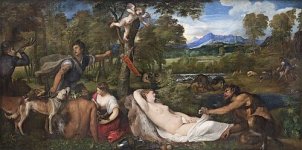
Venus and Adonis, Titian



The Egyptian goddess of the sky, Hathor, ruled over the sun, the stars, the human soul, love, music, dancing, eroticism, fertility, motherhood, fate, incense and proper conduct.


 Thank you so much SG Karnonnos!