"Before the word, there was truth. Before the mother, there was truth. Before the earth received a name, truth was already there, not waiting, but being."
In the dominant Western philosophical tradition, truth is a problem to be solved. Western thought treats truth primarily as an epistemological puzzle, a question of how the mind correctly mirrors an external world. Truth, in this framing, is a property of statements. It belongs to logic, to language, to argument. It is something we assert, verify, or disprove. It is, at its most fundamental, an intellectual achievement.
But what if this conception, however sophisticated, is impoverished from the very start? What if truth is not first a quality of propositions but the ontological ground of all being? What if it is not something the mind discovers but something the soul participates in or falls away from? The Agĩkũyũ philosophical tradition, crystallised in the concept of Maa, demands precisely this radical reorientation.
Maa as an ontological foundation
Maa is not a moral rule. It is not an aspiration. It is, in the most precise philosophical sense, the condition of possibility for all existence. To understand this, one must first resist the temptation to translate it prematurely to reach for the nearest Western equivalent and domesticate its strangeness. Maa is not merely "honesty," the way we mean it when we tell a child not to lie. It is the fabric from which reality is woven.
This becomes luminously clear when we trace the etymology that the Gĩkũyũ cosmology preserves within ordinary speech. The word for mother, Maitũ, is not a separate word. It is Ma iitũ: "Our Truth." The mother is not someone who possesses truth; she is truth in its communal and generative form. She is the source. She is the origin. And in naming the first ancestor Mũmbi, the shaper, the moulder, and binding her identity to truth through this linguistic root, Agĩkũyũ cosmology makes a claim of breathtaking philosophical depth: that the first creative act, the act by which something came from nothing, was an act of truth manifesting itself.
Here, truth precedes matter. Truth precedes time. Truth is not what we say about reality; it is what reality is made of. To live in Maa is to align oneself with the constitutive principle of the cosmos. To violate Maa is not merely to tell a lie; it is to introduce a tear in the fabric of being itself.
Truth as the character of God
In Agĩkũyũ theology, Ngai, the Supreme God, whose very name is borrowed from the Maa people of the Maasai, that vast linguistic and spiritual kinship reaching across East Africa, is not described primarily by power or even by love, as in many religious traditions. God is, at the most fundamental level, the ultimate source of truth. Ngai is not a being who happens to be truthful. Ngai is Maa, truth in its absolute and inexhaustible form.
This is not merely a theological curiosity. It has profound implications for what it means to be human, and especially what it means to lead. If God is truth, then human dignity, the life force (Muoyo/Roho, Traditionally, the life force is seen as a "vibration" or energy connected to the source (God)) that God breathes into persons and communities, is sustained by participation in truth. The leader who practices Maa does not simply govern well by pragmatic standards. They become a conduit for divine energy. The life of the community flows through them because they have not obstructed the channel between the human and the sacred.
Conversely, a leader who betrays Maa does not merely make a political miscalculation. They sever the community's connection to its spiritual source. The cattle weaken. The land grows reluctant. The family's bonds loosen. In Agĩkũyũ's thought, the consequences of falsehood are not merely social; they are cosmological. Untruth is a form of cosmic violence.
Justice as truth made visible in the world
Western jurisprudence tends to separate truth from justice: truth is a factual matter, justice is a normative one. Courts seek facts; philosophers debate values. But Maa dissolves this boundary. In Agĩkũyũ thought, Kĩhooto, justice is not an arrangement that humans design and impose upon facts. It is what truth looks like when it is made manifest in the social world. You cannot have justice without truth, not because you need accurate evidence before rendering a verdict, but because justice is truth taking shape in human relationships.
This is why the council of elders, the Kiama Kia Ma, the Council of Truth, sought not the most persuasive argument, not the most powerful claimant, but the objective truth of the matter itself. The elders served truth; they did not manufacture it. Their authority derived not from rank or rhetoric but from their demonstrated capacity to see clearly, to sit still inside Maa, and to let it speak through them. The Kiama was not a court of law in the Western sense; it was a ceremony of truth-disclosure. Justice was not decided. It was revealed.
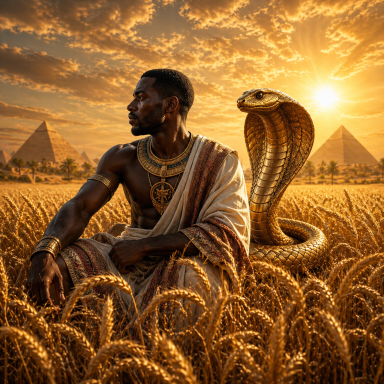
Here one finds a striking convergence across the ancient world. The Egyptian Ma'at Goddess of truth, justice, and cosmic order, whose feather was weighed against the human heart, encodes an almost identical philosophical intuition. That the Gĩkũyũ and Nile Valley civilisations preserved parallel concepts, and that the linguistic resonance of Maa and Ma'at has long been noted in comparative cultural discourse, suggests that these are not isolated regional beliefs but expressions of a deep African philosophical current, a pan-continental understanding that truth is not merely useful but foundational, not merely moral but sacred.
The body of truth: Maitũ and the philosophy of the maternal
Perhaps the most philosophically radical dimension of Maa is the decision encoded in language itself, and therefore beyond any single philosopher's authorship, to identify truth with motherhood. This is not a metaphor. Or rather, if it is a metaphor, it is the kind that has become so foundational that it structures all subsequent reality.
To call the mother "Our Truth" is to say several stunning things simultaneously. First, that truth is not abstract; it has a body, a face, a voice that called us by name before we knew our own names. Truth, in this tradition, is not encountered in the solitude of pure reason. It is first encountered in the warmth of being held, of being seen, of being nourished, before we could ask for nourishment. The mother does not introduce the child to the truth. She is the child's first experience of truth, the truth that they exist, that they are known, that the world is not hostile.
Second, to embed this in the word Maitũ, our truth, not my truth, is to insist that truth is irreducibly communal. There is no private Maa. Falsehood isolates; truth gathers. A community that practices Maa does not merely share information accurately; it becomes, in the deepest sense, a single body of mutual recognition. Each member's truth-telling is an act of love directed at the whole.
This stands in deliberate and productive contrast with the individualism that haunts so much modern Western epistemology, where the solitary mind struggles to verify reality on its own. In the Agĩkũyũ framework, the lone knower is an abstraction, a philosophical fiction. We come to know the truth together, or not at all. The village is the epistemological unit.
Living inside Maa: truth as practice, not possession
Perhaps the most practically transformative insight of this tradition is that Maa is not something one has; it is something one inhabits or falls away from through daily choices. Truth, in this understanding, is not a fixed quality that some people possess and others lack. It is a living relationship, dynamic, fragile, demanding constant renewal through integrity of word and deed.
Wĩhokeku, honesty of character, uprightness in word, is the daily practice by which one remains inside Maa. But notice: it is not defined primarily as "not lying." It is defined as the alignment of one's inner life with one's outer speech, the refusal to let the word become a mask over the face of reality. In a world saturated with strategic communication, curated identities, and the permanent temptation to say what is expedient rather than what is true, the Agĩkũyũ concept of Wĩhokeku reads as a form of spiritual discipline, the daily work of keeping oneself transparent to truth, so that truth may speak through you.
The leader who practices Maa, the elder who adjudicates through Kĩhooto, the mother who embodies Maitũ, these are not extraordinary figures performing superhuman feats of virtue. They are ordinary human beings who have chosen, repeatedly and deliberately, to stay close to the source. Their authority is not power over others. It is the accumulated credibility of a life lived in alignment with what is real.
What the world loses when it forgets Maa
We live in an age of what might be called institutional falsehood, not the outright lie of a single individual, but the slow corruption of the shared frameworks through which communities make sense of reality. When language is used to obscure rather than illuminate, when leadership is understood as performance rather than service, when justice becomes a contest of power rather than a search for truth, something deeper than a political system fails. The ontological ground shifts. The community begins to lose its sense of what is real.
The Agĩkũyũ tradition offers not simply a diagnosis of this condition, but also a memory of what was lost and a path back. When the Kiama Kia Ma, the Council of Truth, sat together under the sacred tree, they were not performing governance only. They were enacting a collective commitment to the principle that reality has a nature, that this nature can be known, that knowing it together is the basis of community, and that any power which does not serve this knowing is not legitimate power but mere force wearing power's clothing.
This is the enduring philosophical gift of Maa: the insistence that truth is not relative, not merely constructed, not simply a weapon in the hands of the powerful, but something that pre-exists us, sustains us, and calls us back to itself when we stray. In this sense, Maa is not a concept belonging to the Agĩkũyũ alone. It is a human inheritance, expressed with particular clarity and depth in one tradition, waiting to be recognised by all who are willing to sit still enough to hear it.
Truth, then, is not what we argue toward. It is what we were born inside of the original ground, the first mother, the nature of God.
Maa does not ask to be discovered. It asks only to be honoured. And in honouring it, we become slowly, imperfectly, communally who we always already were.
TAHARQA.