


Tethys333
Active member
Greetings, everyone!
With a little divine inspiration, I had the idea to start a thread where art is the main focus.
We are all familiar with the major works of art, but often we have never explored them in depth, or many, although beautiful, have never been given the importance they deserve because of the enemies. This thread will be dedicated to describing works of art and maybe even getting you interested in it.
I hope you like this idea and, above all, if you do, I would appreciate your feedback.
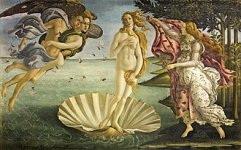
I would like to begin with a particularly famous work, which can be found literally everywhere, namely Sandro Botticelli's "Birth of Venus.”

The work was executed around 1484/1485 for Lorenzo di Pier de' Medici's villa of Castello.
This work has close links with several classical sources: Ovid's Metamorphoses, Pliny's Naturalis Historia (XXXV, 88-91) and one of the Homeric Hymns (VI, 1-6), and, especially with Angelo Poliziano's “The Stanze.”
The chosen theme shows the spiritual meaning that Neoplatonic philosophy attributed to beauty, that is, to Venus. Beauty is considered the splendor of the intelligible world (Ideas, Nous) reflected on sensible matter, acting as a bridge for the asceticism of the soul towards the One.
The enemy has always led people to believe that this work was inspired by the baptism of Christ, but in reality it is quite the opposite, as we find this description in Hesiod's Theogony (8th-7th century BC).
Venus has just been born from the sea foam, but she is already a woman, naked, in her purest and most natural form, sitting on an enormous shell.
She is pushed by Zephyr, embracing Chloris (daughter of Amphion and Niobe, she is the goddess of flowers and blossoming in mythology) towards the coast of the island of Cyprus, where Flora, wearing a white dress adorned with cornflowers, welcomes her, handing her a red cloak (the color of energy, strength, sexual energy, dynamism, passionate love, physical desire, courage, and willpower) sprinkled with daisies to cover her.
Behind Flora, orange trees in bloom stretch their branches towards Venus and the sea.
The landscape is marginal, the waves of the sea are slight, ornamental V-shaped ripples, the coastline is a broken line, which emphasizes the curves of the cloak that Flora offers to Venus. In this way, the viewer's attention is focused solely on the characters (on the intertwining bodies of Zephyr, who is blowing, and Chloris, who is scattering pink flowers, on the nymph on the shore, but above all on the motionless and rosy Venus.
The right side of Venus's figure, dominated by her long, beautiful, blonde hair, tousled by the wind and modestly covering her pubic area, contrasts with the left side of her body, drawn with a continuous, soft line.
Her hair highlights the oval shape of her face, defined by her finely drawn eyebrows, her nostrils tinged with the same slight blush as her cheeks, and her full, red lips. Finally, her light-colored eyes give the newborn Venus an innocent, naive, and dreamy look.
The more I look at the painting, the more I see important symbols, such as the shell, symbol of female intimacy, birth, and procreation.
Stop and look at the painting. Although it was painted during the Renaissance, there was still a great desire to bring classical art and culture back to life. Among those who painted Christian characters, fictional characters, and enemy entities, there were still some who wanted to help bring our Gods back to life.
With a little divine inspiration, I had the idea to start a thread where art is the main focus.
We are all familiar with the major works of art, but often we have never explored them in depth, or many, although beautiful, have never been given the importance they deserve because of the enemies. This thread will be dedicated to describing works of art and maybe even getting you interested in it.
I hope you like this idea and, above all, if you do, I would appreciate your feedback.
I would like to begin with a particularly famous work, which can be found literally everywhere, namely Sandro Botticelli's "Birth of Venus.”
The work was executed around 1484/1485 for Lorenzo di Pier de' Medici's villa of Castello.
This work has close links with several classical sources: Ovid's Metamorphoses, Pliny's Naturalis Historia (XXXV, 88-91) and one of the Homeric Hymns (VI, 1-6), and, especially with Angelo Poliziano's “The Stanze.”
The chosen theme shows the spiritual meaning that Neoplatonic philosophy attributed to beauty, that is, to Venus. Beauty is considered the splendor of the intelligible world (Ideas, Nous) reflected on sensible matter, acting as a bridge for the asceticism of the soul towards the One.
The enemy has always led people to believe that this work was inspired by the baptism of Christ, but in reality it is quite the opposite, as we find this description in Hesiod's Theogony (8th-7th century BC).
Venus has just been born from the sea foam, but she is already a woman, naked, in her purest and most natural form, sitting on an enormous shell.
She is pushed by Zephyr, embracing Chloris (daughter of Amphion and Niobe, she is the goddess of flowers and blossoming in mythology) towards the coast of the island of Cyprus, where Flora, wearing a white dress adorned with cornflowers, welcomes her, handing her a red cloak (the color of energy, strength, sexual energy, dynamism, passionate love, physical desire, courage, and willpower) sprinkled with daisies to cover her.
Behind Flora, orange trees in bloom stretch their branches towards Venus and the sea.
The landscape is marginal, the waves of the sea are slight, ornamental V-shaped ripples, the coastline is a broken line, which emphasizes the curves of the cloak that Flora offers to Venus. In this way, the viewer's attention is focused solely on the characters (on the intertwining bodies of Zephyr, who is blowing, and Chloris, who is scattering pink flowers, on the nymph on the shore, but above all on the motionless and rosy Venus.
The right side of Venus's figure, dominated by her long, beautiful, blonde hair, tousled by the wind and modestly covering her pubic area, contrasts with the left side of her body, drawn with a continuous, soft line.
Her hair highlights the oval shape of her face, defined by her finely drawn eyebrows, her nostrils tinged with the same slight blush as her cheeks, and her full, red lips. Finally, her light-colored eyes give the newborn Venus an innocent, naive, and dreamy look.
The more I look at the painting, the more I see important symbols, such as the shell, symbol of female intimacy, birth, and procreation.
Stop and look at the painting. Although it was painted during the Renaissance, there was still a great desire to bring classical art and culture back to life. Among those who painted Christian characters, fictional characters, and enemy entities, there were still some who wanted to help bring our Gods back to life.
![Ayleth [TG]](/data/avatars/m/0/293.jpg?1762447538)


![Ayleth [TG]](/data/avatars/s/0/293.jpg?1762447538)


