Welcome to the Temple of Zeus's Official Forums!

Welcome to the official forums for the Temple of Zeus. Please consider registering an account to join our community.

The other side: a new way of looking at art

Tethys333

Active member
Joined
May 29, 2024
Messages
897
Website
www.templeofzeus.org
Greetings, everyone!
With a little divine inspiration, I had the idea to start a thread where art is the main focus.
We are all familiar with the major works of art, but often we have never explored them in depth, or many, although beautiful, have never been given the importance they deserve because of the enemies. This thread will be dedicated to describing works of art and maybe even getting you interested in it.

I hope you like this idea and, above all, if you do, I would appreciate your feedback.


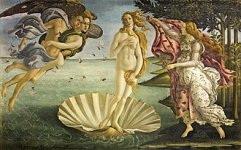
I would like to begin with a particularly famous work, which can be found literally everywhere, namely Sandro Botticelli's "Birth of Venus.

La-nascita-di-Venere-scaled.jpg


The work was executed around 1484/1485 for Lorenzo di Pier de' Medici's villa of Castello.
This work has close links with several classical sources: Ovid's Metamorphoses, Pliny's Naturalis Historia (XXXV, 88-91) and one of the Homeric Hymns (VI, 1-6), and, especially with Angelo Poliziano's “The Stanze.”
The chosen theme shows the spiritual meaning that Neoplatonic philosophy attributed to beauty, that is, to Venus. Beauty is considered the splendor of the intelligible world (Ideas, Nous) reflected on sensible matter, acting as a bridge for the asceticism of the soul towards the One.

The enemy has always led people to believe that this work was inspired by the baptism of Christ, but in reality it is quite the opposite, as we find this description in Hesiod's Theogony (8th-7th century BC).

Venus has just been born from the sea foam, but she is already a woman, naked, in her purest and most natural form, sitting on an enormous shell.

She is pushed by Zephyr, embracing Chloris (daughter of Amphion and Niobe, she is the goddess of flowers and blossoming in mythology) towards the coast of the island of Cyprus, where Flora, wearing a white dress adorned with cornflowers, welcomes her, handing her a red cloak (the color of energy, strength, sexual energy, dynamism, passionate love, physical desire, courage, and willpower) sprinkled with daisies to cover her.

Behind Flora, orange trees in bloom stretch their branches towards Venus and the sea.
The landscape is marginal, the waves of the sea are slight, ornamental V-shaped ripples, the coastline is a broken line, which emphasizes the curves of the cloak that Flora offers to Venus. In this way, the viewer's attention is focused solely on the characters (on the intertwining bodies of Zephyr, who is blowing, and Chloris, who is scattering pink flowers, on the nymph on the shore, but above all on the motionless and rosy Venus.

The right side of Venus's figure, dominated by her long, beautiful, blonde hair, tousled by the wind and modestly covering her pubic area, contrasts with the left side of her body, drawn with a continuous, soft line.
Her hair highlights the oval shape of her face, defined by her finely drawn eyebrows, her nostrils tinged with the same slight blush as her cheeks, and her full, red lips. Finally, her light-colored eyes give the newborn Venus an innocent, naive, and dreamy look.

The more I look at the painting, the more I see important symbols, such as the shell, symbol of female intimacy, birth, and procreation.
Stop and look at the painting. Although it was painted during the Renaissance, there was still a great desire to bring classical art and culture back to life. Among those who painted Christian characters, fictional characters, and enemy entities, there were still some who wanted to help bring our Gods back to life.
 

Attachments

  • El_nacimiento_de_Venus,_por_Sandro_Botticelli.jpg
    El_nacimiento_de_Venus,_por_Sandro_Botticelli.jpg
    32.7 KB · Views: 30
Thank you, TG Ayleth for your feedback!
I was gathering more details about other works of art. I look forward to updating this thread as soon as possible. ☀️
 
Thank you for this Sister Tethys! I love this idea. This painting has always struck me, and I once stumbled upon this ancient mural found in the 1960s dating to before 79 CE in an excavated home in Pompeii. A strikingly similar way of depicting Lady Aphrodite (Aphrodite Anadyomene).


Aphrodite_Anadyomene_from_Pompeii_cropped.jpg
 
Absolutely need to see more of this, we need more commentary on symbolism in art. Very good work, sister.
 
“The chess players” (1831) - Friedrich Moritz August Retzsch

To continue the series dedicated to discovering works of art, today I am here to show you the painting: “The Chess Players” by Friedrich Moritz August Retzsch.

81ngJE9VgtL._AC_UF894,1000_QL80_.jpg


At first glance, it may seem to offer us a Christian interpretation, so to speak. But, upon closer inspection, I have come up with a more accurate interpretation.
Look closely at the painting. It depicts a chess match between a man and the “Devil.” If the Devil wins, he will take the man's soul.

The figurative register features three figures: the man on the right, an angel in the center, and Satan on the left (it's no coincidence that he is positioned on the left).

The man is pensive, reflecting, struggling, but unwilling to give up on finding the move that will save him.

The angel, on the other hand, stands still, doing nothing, looking at the man's side of the chessboard, already knowing the winning move.

Satan watches the man. Yes, many may say with malice, but let's look deeper.

At first glance, one might think that the angel will “save” the man, but what is the angel actually doing to help him? Nothing: he stands there watching with his hands clasped together, a sign of closure, of non-communication, almost as if he thinks there is no hope for the man's salvation. But who will really save him?

Satan looks at him, not angry because he wants his soul, angry, or rather severe with him, because he knows that man himself can do it on his own, with his own strength.

For those unfamiliar with chess and its rules, white moves first, which means that with the first move, it can choose whether the game will be in its favor or not. In this case, the man brought this on himself; he was the one who ended up in that situation, and Satan wants him to learn how to get out of it on his own.

According to many studies conducted on this painting, observing the chessboard they saw that there is one move that could be a winning move for man and one for Satan.

Look at Satan: he recognizes that there may be a winning move and that man is not doomed. Satan is the only one who truly believes in man and his abilities. The angel does not. He stands firm. He says he can help him, but then he does not.

Furthermore, if you look closely at the table, you will notice a small spider moving towards the man. The Christian interpretation is that this further intensifies Satan's deception of man.
I have two interpretations: the first is based on the concept of illusion, that the angel is man's true helper as opposed to Satan.

The other is the spider seen as a weaver of webs, linked to the concept of Dharma: in some interpretations related to Shiva, the spider's web represents the perfect order of the cosmos. Shiva is the central point, immobile and calm, while the “web” of life vibrates around him.
This teaches that even if life seems complicated and tangled like a spider's web (man in difficulty as he is in the game of chess), there is always a divine center (Shiva, Satan to the rescue) that holds everything together in perfect balance.

This may seem irrelevant, but that little spider could say a lot about Satan's intentions.


Finally, I would like to focus on the symbolism of the colors of the robes, which I do not believe to be coincidental. Based on what we said earlier, look at the man's robe. According to the ToZ website, the color blue indicates: "Truth, wisdom, protection, inner peace, loyalty, occult power, and expansion. Jupiter rules royal blue: luck, expansion, abundance, prosperity, and opportunity. Spirituality, evocation of demons, healing, inspiration, devotion, serenity, sincerity, and truth, loyalty, inner peace, knowledge and wisdom, harmony in the home, occult power, and expansion."

Satan's robe is red, the color of the base chakra, connected to Satan, Shiva, and the masculine side of the individual. "Red can also be used for self-confidence. It encourages courage, willpower, and competitiveness."

Now let's take a look at what white (the angel's robe) can cause if not used for purification: "white can be used to incite corruption and bring about impotence. White can also be used to create weakness, neurosis, and fear."

Looking more closely, the tables have been turned.

Therefore, arise and win glory; defeat your enemies and enjoy a prosperous kingdom. They have already been killed by Me: you are merely the instrument.” - Bhagavad Gita (11.33)
 
“The chess players” (1831) - Friedrich Moritz August Retzsch
(...)

The theme of courage can also be seen in the lion motif on the seat.

The helmet with a feather can also be interpreted symbolically. It almost looks like the God of War, Mars, teaching his disciple to think strategically and be aware of the challenges of life.

Note the gargoyle-like figures watch from below, symbolizing protection and divine insight. They are almost on the same level as the “angel,” but you can see that they come from above.
 
The theme of courage can also be seen in the lion motif on the seat.

The helmet with a feather can also be interpreted symbolically. It almost looks like the God of War, Mars, teaching his disciple to think strategically and be aware of the challenges of life.

Note the gargoyle-like figures watch from below, symbolizing protection and divine insight. They are almost on the same level as the “angel,” but you can see that they come from above.
Beautiful point of view, TG Ayleth!
I also notice the piece Satan is holding: the Queen, the most important piece in chess. He has it in his hand but is waiting to use it, perhaps to indicate to the man which piece to use or simply to make the game even more difficult so that the man can continue to give it his all.
 
THE SCHOOL OF ATHENS (1509-1510) - Raphael


1774972648352.png


Today I’d like to describe one of the works that has most shaped my life over the past four years: “The School of Athens” by Raphael, and delve a little deeper into the discovery of this fresco.

But first, I must make a preliminary remark.
Upon arriving in Rome, Raphael was commissioned by Pope Julius II to paint the Vatican Rooms, in the rooms of the pope’s new apartment on the second floor of the Apostolic Palace, where many artists were already at work.

Raphael began painting the Room of the Signatura, which also served as Julius II’s private library and the meeting place for the Curia’s tribunal.

In The School of Athens, Raphael sought to depict one of the paths leading to God (the True, in every sense): philosophy.
The setting is a classical building, somewhat reminiscent of ancient Roman baths.

The site brings together the most important philosophers of antiquity.
The visible portion of the building consists of two wings covered by barrel vaults¹ with coffered ceilings² featuring alternating hexagons and rhombuses flanking a coupled space.

A flight of steps leads up to the building. On the steps and on the landings of the two levels they connect, the artist has arranged the philosophers in a semicircular formation around the central figures of Plato and Aristotle. The former (who is depicted holding his book "Timaeus") points toward the sky, or rather, the world of Ideas.

*As we recall from Plato’s philosophy, the earthly (or sensible) world is an imperfect, changeable, and finite copy of the world of Ideas (the hyperuranion), fashioned by the Demiurge in the likeness of eternal models. It is the realm of opinion (doxa), subject to birth and death, perceived through the senses and characterized by chaotic matter that limits divine perfection. perceived through the senses and characterized by chaotic matter that limits divine perfection.

Aristotle (holding the book "Ethics" resting on his left thigh), with one arm extended before him, is implying that the only possible reality is the concrete one in which we live, the sensible world, that is, the one perceivable through the senses (even though Aristotle asserts that the earthly world is imperfect and incorruptible; there is much to be said about that).

The vanishing point³ of the perspective is situated between the two greatest philosophers of all time, lending the fresco a sense of balance, classical elegance, and great composure.

Even the two seemingly incongruous figures of Heraclitus and Diogenes the Cynic, lying awkwardly on the stairs, contribute to this sensation: in fact, the inclination of their bodies follows that of the vanishing lines.

Raphael depicted some of the philosophers with the features of his contemporary artists (including himself: he is the young man in the dark cap looking outside the composition, at the far lower right) to symbolize the ideal thread linking the educated men of his time with those of the past.

Bramante is portrayed as Euclid, who, on the right, is bent over drawing geometric figures with a compass; Michelangelo is portrayed as Heraclitus. The latter was not actually part of the original design, so much so that he does not appear in the preparatory sketch.

We can also see Pythagoras, in the lower left corner, engrossed in a book, likely studying or drawing geometric figures.
Next to Plato, a little further to the left, we can see Socrates, dressed in green, deep in conversation.

Finally, I would like to draw your attention to the two sculptures on the walls of the area where the philosophers are depicted: on the left, likely the god Apollo, depicted with a lyre (or kithara), representing Intellect in this context.

On the right is the goddess Athena, goddess of wisdom and intellect.

Raphael celebrates the eternal value of knowledge, showing how, despite the passage of time, the origins of philosophical thought remain fundamental and continue to live on in human culture and knowledge.

___________________________________________________________________________________________________________________

1. The barrel vault is one of the simplest types of non-flat roof systems used to cover generally rectangular spaces. It has the shape of a semicircle. Two barrel vaults that intersect at right angles form a cross vault.
2. Coffered ceilings, also known as paneled ceilings, are decorative architectural elements consisting of recessed panels (usually square, rectangular, or octagonal) arranged in a regular pattern on ceilings, vaults, or domes. This technique creates a striking visual effect, lightens the structure, and often conceals load-bearing beams, with roots dating back to classical timber construction.
3. The vanishing point is a fundamental concept in linear perspective, representing the point on the horizon line where parallel and converging lines appear to meet and disappear into infinity, creating the illusion of depth on a two-dimensional surface. It can be central (frontal), accidental (with two points), or oblique (with three points).
 

Official Temple of Zeus Links

Back
Top