


Kouros Aionios
Member
- Joined
- Nov 25, 2024
- Messages
- 424
Background
In Ancient China, Acupuncture emerged well over 2,000 years ago. The earliest written records describing acupuncture appear in classical Chinese medical texts such as the Huangdi Neijing (The Yellow Emperor’s Inner Canon), which dates back to around 200 BCE. This foundational text describes the body as being governed by a system of channels or “meridians” through which vital energy, known as qi, flows.
Here we know these channels as "nadis" and the qi as "prana" or bioelectricity; it is the same phenomenon described in a different language. According to the Ancients, various illnesses of the body and mind occur when this qi is blocked, unbalanced between the Yin (Feminine Energy) and Yang (Masculine Energy), or not flowing properly through the meridians.
Acupuncture was invented to restore movement of qi through the meridians and loosen blockages in the body by targeting very particular sensitive areas that serve as major connecting points of these channels throughout the body; what we know as the Chakras are the most significant of these connecting points. Besides the main 7 Chakras, there are many smaller minor points all over the body that serve various functions, some of which I will be sharing with you all today.
You do not need any needles for these points; all you need are your fingers and some precision. You apply a decent amount of pressure on the given point with your finger, keeping it steady and still on the point for about 1-2 minutes. You can also massage the point with your thumb with a decent amount of pressure for 1-2 minutes.
Without further ado, these are the acupuncture points that I consider most useful in my day-to-day life and spiritual practice:
HT7, Heart 7, Shenmen "Spirit Gate"
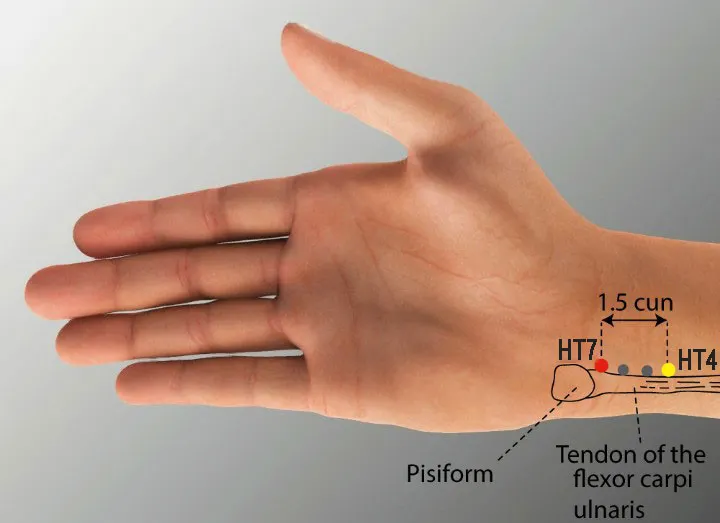
Located
On the pinky side of your wrist
On the wrist crease
In the soft depression (not on the bone)
Use for: Fear, spasm, sadness, anxiety, insomnia, enuresis, timidity, impotence, depression, indecision, poor memory, restlessness, palpitations, scanty periods, loss of libido, tremor of limbs, Parkinson’s disease, and inappropriate laughter.
In Chinese thought, the heart is the gateway to the Shen (Spirit). This point is said to settle the spirit and relax a restless or overactive nervous system and mind.
This is my favorite point that I use almost every day. As someone with quite an overactive mind, I find this really helps me calm down and think with a much clearer head. This is also a great point for restlessness before and while trying to go to sleep; if you have a restless mind that flares up at night, this point is a lifesaver. Any stress, anxiety, fright, fear, or worry is instantly alleviated by applying this point.
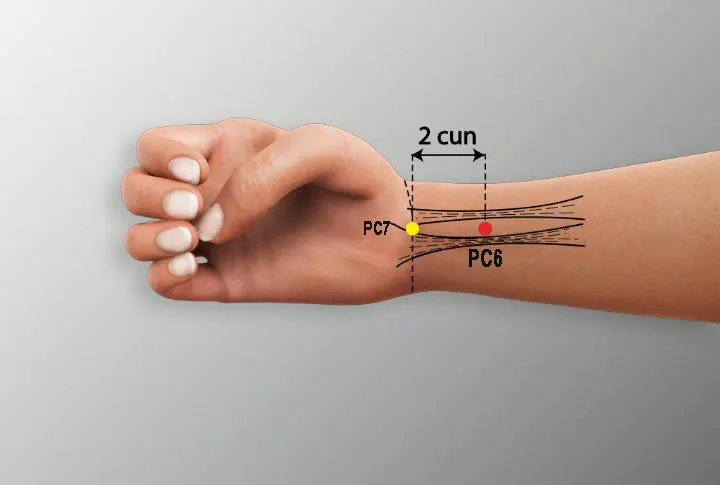
Located
On the inner forearm (palm side)
About 2–3 finger widths above the wrist crease
In the center line between the two forearm tendons
Use for: Nausea, vomiting, motion sickness, anxiety, palpitations, chest tightness, insomnia, stress, emotional overwhelm, and calming the mind during panic or nervousness.
In Chinese thought, the Pericardium protects the Heart, acting like a “buffer” between emotions and the heart itself. This point is said to help open the chest, regulate Qi, and calm emotional turbulence.
This is a widely used point in both traditional and modern settings, especially for nausea and anxiety-related symptoms. Many people find it helpful when feeling tense, overwhelmed, or physically unsettled. I believe PC6 is more effective than HT7 for more physical/bodily symptoms of anxiety, while HT7 is better for more mental, emotional, and spiritual symptoms.
LI4 Large Intestine 4 Hegu “Joining Valley”
(Warning: avoid strong stimulation during pregnancy unless guided by a qualified practitioner.)
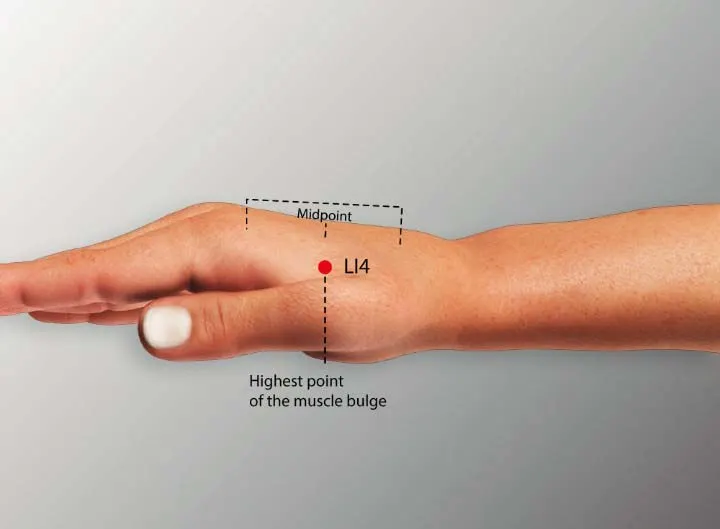
Located
On the back of the hand (not palm side)
In the web between thumb and index finger
In the highest part of the soft fleshy “valley” where the thumb and index finger meet when brought together
Use for: headaches (especially frontal), facial pain, toothache, sinus congestion, stress, anxiety, general pain relief, fever, neck and shoulder tension, constipation, and cramping pain patterns
In Chinese thought, this is a powerful “command point” for the face and head. It is said to strongly move Qi and blood, release blockages, and disperse “wind” and “heat” that affect the upper body. It helps regulate defensive Qi and is used to open circulation when there is tension, stagnation, or emotional constraint. Because of its strong moving effect, it is often used to “unblock” stuck patterns in both the body and mind
This is a very commonly used point in acupuncture and acupressure. It is often used when there is tension, pain, or stress that feels “stuck” in the head or face, and I find it produces a noticeable sense of release or relief when stimulated.
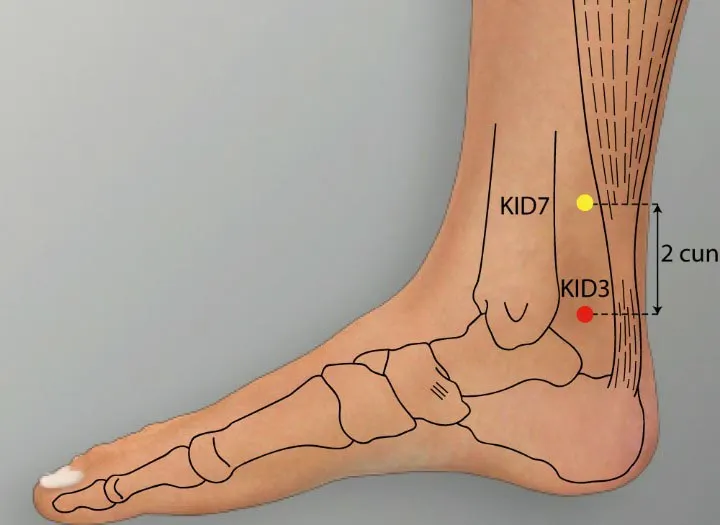
Located
On the inner ankle
In the soft hollow between the inner ankle bone (medial malleolus) and the Achilles tendon
Level with the tip of the inner ankle bone
Use for: restoring vital energy, lower back pain, weak knees, fatigue, dizziness, tinnitus, anxiety, insomnia, feeling drained, and general weakness or “low energy” states
In Chinese thought, this is the main “yuan-source” point of the Kidney channel. It is said to strongly nourish Kidney Qi, Kidney Yin, and Kidney Yang depending on how it is used. The Kidney system is associated with deep vitality, essence (Jing), growth, aging, bones, and foundational energy. KI3 is considered a key point for restoring depleted energy and stabilizing the body’s core balance. It is also used to calm the mind when anxiety or restlessness is linked to deficiency of Kidney energy
This is one of the most foundational points in acupuncture for strengthening overall vitality and supporting long-term energy balance. It is a great point to rejuvenate the body, mind, and soul.
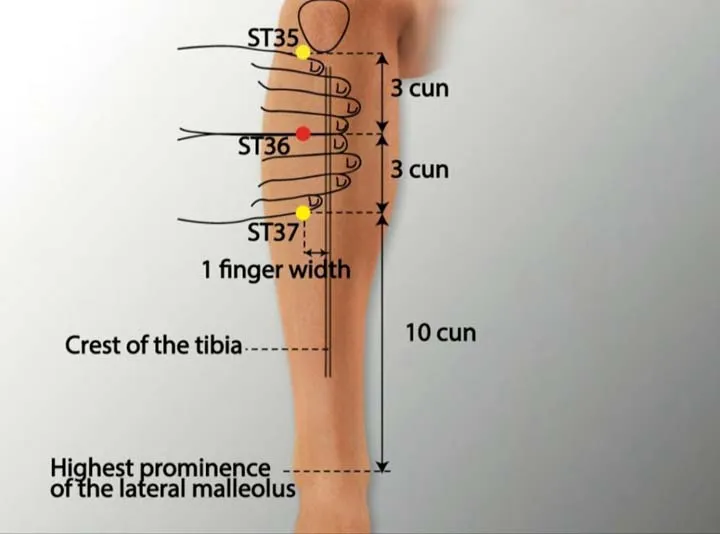
Located
On the lower leg
About four finger widths below the kneecap
One finger width to the outside of the shin bone
In a soft muscle depression beside the tibia
Use for: fatigue, low energy, weak immunity, poor digestion, nausea, bloating, diarrhea, constipation, stress-related stomach symptoms, general weakness, and recovery after illness
In Chinese thought, this is one of the most important “tonifying” points in the body. It is said to strengthen the Spleen and Stomach system, which are responsible for transforming food into Qi (energy). Because of this, it is considered a foundation point for building overall vitality and endurance. It is also traditionally described as supporting “postnatal Qi,” meaning the daily energy that sustains physical strength, mental clarity, and immune function. In classical theory, it helps regulate the flow of Qi in the digestive system and restore balance when the body feels depleted or weakened
Modern research suggests it may influence the autonomic nervous system, inflammation pathways, and gut motility, which helps explain why it is widely studied for digestion, fatigue, and systemic regulation
This is an extremely important acupuncture point because it has multiple functions and supports overall energy and resilience rather than targeting just one symptom.
The End
These are the best acupuncture points I can recommend to my fellow Zevists. I hope you all enjoyed this and that these points help you on your spiritual journey!
HAIL KHEIRON!
HAIL ZEFS!!!
In Ancient China, Acupuncture emerged well over 2,000 years ago. The earliest written records describing acupuncture appear in classical Chinese medical texts such as the Huangdi Neijing (The Yellow Emperor’s Inner Canon), which dates back to around 200 BCE. This foundational text describes the body as being governed by a system of channels or “meridians” through which vital energy, known as qi, flows.
Here we know these channels as "nadis" and the qi as "prana" or bioelectricity; it is the same phenomenon described in a different language. According to the Ancients, various illnesses of the body and mind occur when this qi is blocked, unbalanced between the Yin (Feminine Energy) and Yang (Masculine Energy), or not flowing properly through the meridians.
Acupuncture was invented to restore movement of qi through the meridians and loosen blockages in the body by targeting very particular sensitive areas that serve as major connecting points of these channels throughout the body; what we know as the Chakras are the most significant of these connecting points. Besides the main 7 Chakras, there are many smaller minor points all over the body that serve various functions, some of which I will be sharing with you all today.
You do not need any needles for these points; all you need are your fingers and some precision. You apply a decent amount of pressure on the given point with your finger, keeping it steady and still on the point for about 1-2 minutes. You can also massage the point with your thumb with a decent amount of pressure for 1-2 minutes.
Without further ado, these are the acupuncture points that I consider most useful in my day-to-day life and spiritual practice:
HT7, Heart 7, Shenmen "Spirit Gate"
Located
On the pinky side of your wrist
On the wrist crease
In the soft depression (not on the bone)
Use for: Fear, spasm, sadness, anxiety, insomnia, enuresis, timidity, impotence, depression, indecision, poor memory, restlessness, palpitations, scanty periods, loss of libido, tremor of limbs, Parkinson’s disease, and inappropriate laughter.
In Chinese thought, the heart is the gateway to the Shen (Spirit). This point is said to settle the spirit and relax a restless or overactive nervous system and mind.
This is my favorite point that I use almost every day. As someone with quite an overactive mind, I find this really helps me calm down and think with a much clearer head. This is also a great point for restlessness before and while trying to go to sleep; if you have a restless mind that flares up at night, this point is a lifesaver. Any stress, anxiety, fright, fear, or worry is instantly alleviated by applying this point.
PC6, Pericardium 6, Neiguan “Inner Pass”
Located
On the inner forearm (palm side)
About 2–3 finger widths above the wrist crease
In the center line between the two forearm tendons
Use for: Nausea, vomiting, motion sickness, anxiety, palpitations, chest tightness, insomnia, stress, emotional overwhelm, and calming the mind during panic or nervousness.
In Chinese thought, the Pericardium protects the Heart, acting like a “buffer” between emotions and the heart itself. This point is said to help open the chest, regulate Qi, and calm emotional turbulence.
This is a widely used point in both traditional and modern settings, especially for nausea and anxiety-related symptoms. Many people find it helpful when feeling tense, overwhelmed, or physically unsettled. I believe PC6 is more effective than HT7 for more physical/bodily symptoms of anxiety, while HT7 is better for more mental, emotional, and spiritual symptoms.
LI4 Large Intestine 4 Hegu “Joining Valley”
(Warning: avoid strong stimulation during pregnancy unless guided by a qualified practitioner.)
Located
On the back of the hand (not palm side)
In the web between thumb and index finger
In the highest part of the soft fleshy “valley” where the thumb and index finger meet when brought together
Use for: headaches (especially frontal), facial pain, toothache, sinus congestion, stress, anxiety, general pain relief, fever, neck and shoulder tension, constipation, and cramping pain patterns
In Chinese thought, this is a powerful “command point” for the face and head. It is said to strongly move Qi and blood, release blockages, and disperse “wind” and “heat” that affect the upper body. It helps regulate defensive Qi and is used to open circulation when there is tension, stagnation, or emotional constraint. Because of its strong moving effect, it is often used to “unblock” stuck patterns in both the body and mind
This is a very commonly used point in acupuncture and acupressure. It is often used when there is tension, pain, or stress that feels “stuck” in the head or face, and I find it produces a noticeable sense of release or relief when stimulated.
KI3 — Kidney 3, Taixi “Great Stream”
Located
On the inner ankle
In the soft hollow between the inner ankle bone (medial malleolus) and the Achilles tendon
Level with the tip of the inner ankle bone
Use for: restoring vital energy, lower back pain, weak knees, fatigue, dizziness, tinnitus, anxiety, insomnia, feeling drained, and general weakness or “low energy” states
In Chinese thought, this is the main “yuan-source” point of the Kidney channel. It is said to strongly nourish Kidney Qi, Kidney Yin, and Kidney Yang depending on how it is used. The Kidney system is associated with deep vitality, essence (Jing), growth, aging, bones, and foundational energy. KI3 is considered a key point for restoring depleted energy and stabilizing the body’s core balance. It is also used to calm the mind when anxiety or restlessness is linked to deficiency of Kidney energy
This is one of the most foundational points in acupuncture for strengthening overall vitality and supporting long-term energy balance. It is a great point to rejuvenate the body, mind, and soul.
ST36 — Stomach 36, Zusanli “Leg Three Miles”
Located
On the lower leg
About four finger widths below the kneecap
One finger width to the outside of the shin bone
In a soft muscle depression beside the tibia
Use for: fatigue, low energy, weak immunity, poor digestion, nausea, bloating, diarrhea, constipation, stress-related stomach symptoms, general weakness, and recovery after illness
In Chinese thought, this is one of the most important “tonifying” points in the body. It is said to strengthen the Spleen and Stomach system, which are responsible for transforming food into Qi (energy). Because of this, it is considered a foundation point for building overall vitality and endurance. It is also traditionally described as supporting “postnatal Qi,” meaning the daily energy that sustains physical strength, mental clarity, and immune function. In classical theory, it helps regulate the flow of Qi in the digestive system and restore balance when the body feels depleted or weakened
Modern research suggests it may influence the autonomic nervous system, inflammation pathways, and gut motility, which helps explain why it is widely studied for digestion, fatigue, and systemic regulation
This is an extremely important acupuncture point because it has multiple functions and supports overall energy and resilience rather than targeting just one symptom.
The End
These are the best acupuncture points I can recommend to my fellow Zevists. I hope you all enjoyed this and that these points help you on your spiritual journey!
HAIL KHEIRON!
HAIL ZEFS!!!




![Lucius Invictus [NG]](/data/avatars/s/69/69213.jpg?1767423438)
