

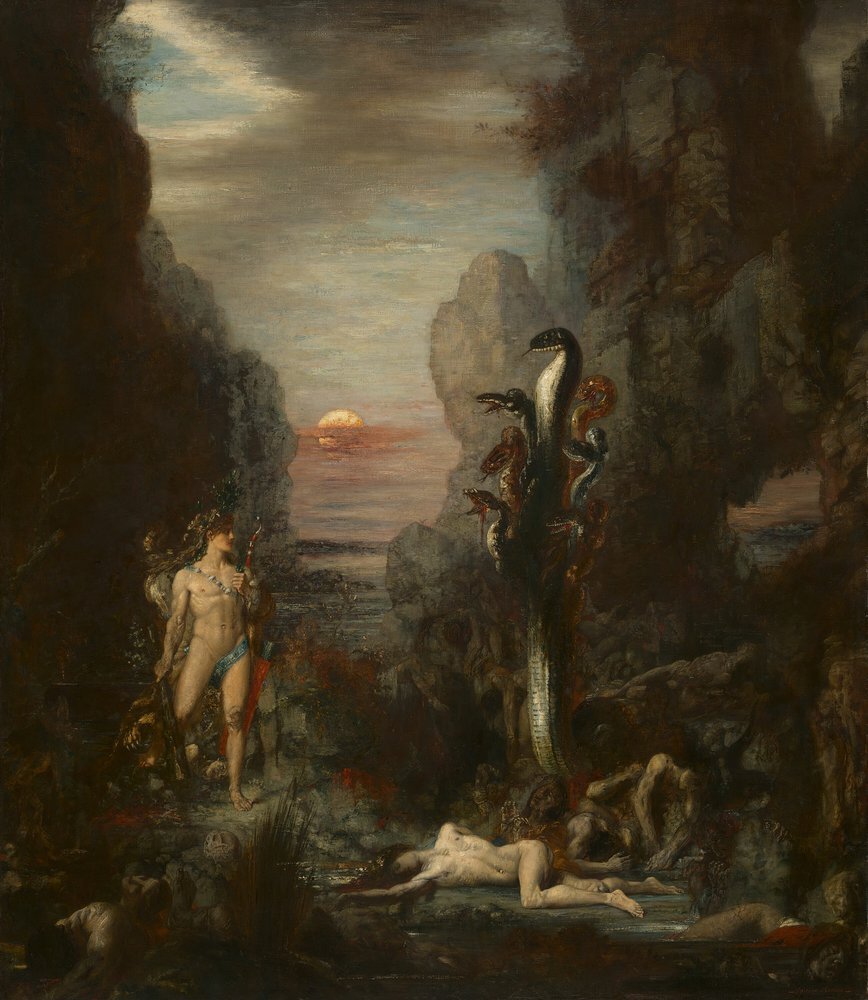
Hercules and the Lernaean Hydra
Gustave Moreau, 1875–76 — Oil on canvas, The Art Institute of Chicago
THE MYTH: HERCULES’ SECOND LABOUR
To fully understand Moreau’s choices, it is necessary to retrace the mythological story from which the work draws its inspiration. The slaying of the Lernaean Hydra is the second of the twelve labours imposed on Heracles, a punishment the hero must endure for having, in a fit of madness induced by the goddess Hera, killed his wife Megara and their children. It is Eurystheus, king of Tiryns, who imposes the labours as penance, and the second of these leads him to the marshes of Lerna, in the Peloponnese, where a terrifying monster is wreaking havoc amongst the livestock and the local population.
Hydra is the daughter of Typhon and Echidna, and thus belongs to that lineage of chthonic monsters which Greek mythology traces directly back to the primordial forces of the Earth: an origin that emphasises her ancestral and almost geological nature, closer to the chaos of the beginning than to the order of the world inhabited by humans. The monster has a serpentine body and numerous heads, ancient sources vary between nine and fifty, though the most widespread tradition sets the number at nine, and a breath so poisonous that merely breathing it in can kill. Its most fearsome characteristic, however, is its ability to regenerate: for every head severed, two more sprout in its place, rendering the creature virtually invincible to anyone attempting to slay it by force alone.
Hercules undertakes the task alongside his nephew Iolaus, who acts as his assistant: according to the best-known version of the myth, it is Iolaus who comes up with the decisive idea, suggested by the goddess Athena, to cauterise each stump with a burning ember immediately after Hercules severs the head, thus preventing the blood spurting from the wound from sprouting new heads. It is only thanks to this strategy, which combines the hero’s physical strength with his companion’s tactical ingenuity, that the Hydra is finally defeated: the last head, the central and immortal one, is buried beneath an enormous boulder, whilst Hercules dips his arrows in the monster’s poisonous blood, turning them into lethal weapons that will accompany him on many of his subsequent labours.
The myth of the Hydra has endured through the centuries precisely because of the symbolic power of its core narrative: an evil that multiplies the very moment it is struck is the perfect metaphor for any threat that cannot be defeated by a direct approach, but requires intelligence, patient strategy, and sometimes the help of an ally. It is no coincidence that the expression ‘cutting off one of the Hydra’s heads’ has survived in everyday language to describe complex problems that regenerate in new forms every time one believes they have been resolved.
THE MOMENT BEFORE THE BATTLE
Gustave Moreau exhibited this painting at the Paris Salon in 1876, at a time when French academic painting was still grappling with the relationship between myth and morality, while the artist, already established as a distinctive voice of Symbolism, chose to reinterpret the struggle just described not as an episode of action, but as a scene of psychological suspense. The moment chosen is neither that of the clash nor that of Iolaus’s decisive intervention with the burning ember, but rather the instant immediately preceding all of this: the hero stands still, the Hydra is alert, and between them lies a stretched-out moment in time in which the entire meaning of the painting is concentrated.
It is a bold narrative choice, because it deprives the viewer of the satisfaction of action and forces them, along with Hercules, to fix their gaze on the horror before it is neutralized. Here we sense all of Moreau’s late-Romantic sensibility; he was Delacroix’s heir in terms of color sense but was already moving toward a mental, interior style of painting, where the drama is no longer played out through the muscles but through the eyes.
THE ARCHITECTURE OF THE SCENE
The composition is based on a distinct vertical counterpoint: on the left, standing alone on a rocky outcrop that serves almost as a pedestal, the figure of Hercules rises with the solemn rigidity of an ancient statue; on the right and in the center, the Hydra unfurls like a many-headed organic mass, its heads rising in a radial pattern from a serpentine body that blends into the darkness of the cave. This cave, carved deep into the background of the canvas, acts as a sort of generative abyss: not merely a lair, but a symbolic threshold between the ordered world of light and the indistinct, chthonic realm from which the monster seems to emerge endlessly.
At the Hydra’s feet, scattered across the ground like a macabre carpet, lie the bodies of previous victims: a detail that Moreau introduces not out of a taste for bloodshed, but to establish an implicit narrative temporality, a “before” that hangs over the scene and heightens Hercules’s awareness of what awaits him. The diagonal arrangement of these bodies also guides the viewer’s eye from the lower left toward the upper right, in a movement that culminates precisely at the monster’s highest heads, the most menacing ones, those still intact and alert.
THE GAZE OF HERCULES: HEROISM AS AN INNER TENSION
It is in his psychological portrayal of the hero that Moreau demonstrates his departure from the academic tradition of myth. Hercules’s body, rendered with a soft chiaroscuro that owes much to the influence of Michelangelo and Hellenistic sculpture, is not captured in the momentum of movement, but in an almost sacred stillness. His shoulders are broad, and the muscles of his chest and arms are taut, but it is a restrained tension, not yet released into action: the body seems to be accumulating energy rather than expending it, like a bow drawn just before the arrow is released.
The face, cast in shadow and turned upward toward the monster’s heads, conveys a complex and ambivalent emotion. There is no fear in the common sense of the word, but something more subtle: a contemplative vertigo, the lucid awareness of facing an enemy that cannot be understood or defeated by force alone. In the myth, striking one of the Hydra’s heads means causing two more to grow in its place: Hercules knows this, and his stillness is therefore not hesitation, but calculation, anticipation, and concentration. It is the gaze of one who, for the first time, takes stock of the true magnitude of the task before allowing himself to be guided by the instinct of action.
This artistic choice transforms the myth into a metaphor for the human condition in the face of the unknown: Moreau’s heroism is never immediate, never overt, but meditative, almost religious. Observing the stiffness of his neck and the steadfastness of his gaze, one senses a controlled breath, a heartbeat deliberately calmed so as not to be overwhelmed by the proliferation of heads, by their silent and uninterrupted hissing.
THE HYDRA: HORROR TRANSFORMED INTO PRECIOSITY
If Hercules embodies the steadfastness of reason, the Hydra is the pictorial triumph of multiplication and the elusive. Moreau treats each head of the monster with an almost goldsmith-like precision, worthy of a miniaturist: the scales are rendered with touches of brilliant color, golden and emerald green, that evoke the effect of enamel and set gemstones, while the small, glassy eyes capture reflections of light that make them eerily lifelike. This detail reveals Moreau’s artistic training, deeply rooted in Orientalist and Byzantine aesthetics, and here it serves a specific purpose: to render the monster not merely repulsive, but seductive in its very monstrosity.
This ambivalence, horror and fascination combined, is a hallmark of late-nineteenth-century Symbolist sensibility, which sees in the feminine and chthonic monstrous a projection of modern man’s inner fears: the Hydra thus becomes the visible image of a terror that is not merely external but psychological, the sculptural embodiment of an enemy that regenerates from the very act of being fought, just as the irrational anxieties of the mind do not dissipate when struck once, but multiply, change form, and return.
LIGHT, COLOUR AND THE LINE BETWEEN ORDEN AND CHAOS
The overall color palette is dominated by earthy, somber tones: browns, ochres, deep greens, that evoke the materiality of rock and shadow, punctuated by brighter, golden, and reddish glints that are selectively concentrated on Hercules’s body and the monster’s nearest heads. This light, which comes from a high, diffuse source with almost no precise naturalistic location, possesses a sacred, almost liturgical quality: it does not illuminate the scene uniformly, but rather selectively highlights the hero, isolating him in a bright halo that sharply separates him from the darkness of the cave.
This dramatic chiaroscuro is not merely a technical device for modeling volume, but constructs a veritable symbolic geography of the painting: light is the domain of heroic consciousness, while shadow is the indistinct realm of instinct and primordial chaos. By following the tonal contrast, the viewer physically perceives the threshold that Hercules is about to cross, and with it the symbolic stakes of the impending clash: not merely a victory of brute strength, but the assertion of rational order over the chthonic and manifold forces of the underworld.
THE MYTH REINTERPRETED THROUGH A SYMBOLIST LENS
As part of Moreau’s artistic oeuvre, this work engages with an entire body of work dedicated to mythological figures suspended between fascination and menace, think of Oedipus and the Sphinx, in which the encounter between the hero or victim and the monstrous figure always becomes an opportunity for a broader reflection on the human psyche, desire, fear, and knowledge. Significantly, Moreau also removes Iolaus from the scene, even though he is an indispensable figure in the myth’s narrative resolution: his absence is not an oversight, but a choice that places the full emotional burden of the confrontation on Hercules, isolating him in his heroic solitude. "Hercules and the Lernaean Hydra" thus fits into this tradition as one of the most contemplative and least spectacular interpretations of the Herculean repertoire, precisely because it rejects the rhetoric of brute force to explore the inner dimension of courage.
In this light, the true subject of the painting is not so much Hercules’ victory, which the myth already knows, and which the painting leaves out of the frame, as the psychological moment of acceptance: the instant in which the hero recognizes the nature of the evil he must face, gauges its multifaceted complexity, and decides, in silence, not to look away. It is in this moment of suspension, rather than in any gesture of strength, that Moreau locates the true essence of heroism: a battle fought first in the gaze, and only later in the arm.
CONCLUSION
Hercules and the Lernaean Hydra is, therefore, a work that transcends mere mythological illustration to become a visual meditation on the nature of courage and the unknown. Through a masterful balance of compositional rigor, decorative refinement, and dramatic lighting, Gustave Moreau transforms an episode of physical strength into an exploration of the hero’s inner solitude, offering the viewer not the spectacle of victory, but the rarest and most intense experience of the threshold: that suspended, silent moment in which all heroism truly begins.
"I am ever present to help all who trust in me and call upon me in time of need."- Al-Jilwah
About Zeus: Father Zeus
Account X: @Asphodelium_
Zeus is God, believe in Him
