

Khem Nefermed
Active member
- Joined
- Jun 26, 2024
- Messages
- 825
Disclaimer: The contents of this essay are a study and analysis of religious ideology and religious practice. While the article discusses and critiques specific doctrines, symbols, institutions, and historical developments within religious traditions from the perspective of the Zevist framework, it does not target or attack any individual or group on the basis of identity or ethnicity. Polemical language is used as per my own expressive liberty, but the article fully conforms with principles of respectful discourse, academic inquiry, and lawful expression, and does not endorse harassment, hate or harm against any individual or group.
I was studying some Eastern Orthodox material to point out symbolism and doctrine that already existed within ancient religions, and ended up making this an entire essay about the Schema Monk order, its practices, its symbolism and its history. This essay describes the monk order and fully exposes the problems with it, the symptoms of Yehuboric influence as well as the symbolic theft. It is rightfully called theft because, unlike other ancient religions which did engage in syncretism and development, christian sects take these concepts, use them, and then claim that they invented them or that theirs are the only sacred ones, while calling the sources of these symbols evil and demonic.
This essay might or might not become a series. If it does, the next "priesthood" I will discuss in an essay will be a historical analysis of Buddhism, as well as how many of the schools of thought that developed which show Yehuboric characteristics.
There will also be a parallel series detailing the operations and mysteries (what we know) of various Priesthoods and orders that align with Zevism. When an essay about those comes out, I will drop it in a reply to this post.
The "Great Schema" Monastic Order
The Great Schema (Greek: Μεγάλο Σχήμα, Megalo Schema) represents the most radical form of monastic commitment within the Eastern Orthodox Church. The term schema itself means “form" or “state”, representing a state of being for the Orthodox faithful. The imagery that this order uses is that of the "living martyr", someone that has "died and been reborn", similar to groups like the Orphic Mystery School. What this article will expose is that, spiritually, the "death" is certainly there, but I am yet to discover the "rebirth".
At its core, the Great Schema is understood as the culmination of the monastic path: a life that seeks the death of "worldly identity" and embodiment of what is described as an “angelic state" (elaboration later). The schemamonk is a practitioner of asceticism, and an "icon" of the "eschatological (Eschaton - post-end-of-the-world existence) reality" of Orthodoxy, and the logical conclusion to the path that christianity lays out.
Historical Emergence and Eastern Monasticism
The roots of the Great Schema lie in the early centuries of christian monasticism, particularly in the ascetic movements of the Egyptian and Syrian deserts during the 3rd and 4th centuries, also known as the "Desert Fathers" (quite an ironic and accurate name, if I'm allowed some derision). These early monks, driven by a desire for devotion and renunciation of the world, withdrew from society to pursue lives of solitude, prayer, and extreme "discipline". Nothing new under the Sun, and deeply criticized by Zevism, but the rabbit hole goes deeper.
Figures such as Anthony the Great are often seen as foundational to the Schema, though the formal category of the Great Schema did not yet exist. Instead, what emerged was a varied spectrum of ascetical intensity. Over time, as monastic life became more structured, especially through communal (cenobitic) systems, the need arose to formally distinguish between varying degrees of commitment.
Monasticism gradually evolved into a tiered system, particularly within Byzantine practice. Typically, this included stages such as the novice (postulant), the rassophoros (robe bearer), the stavrophoros (cross bearer), and finally, the Great Schema. We will lightly touch on the symbolism of the others, but for the most part, looking at the Great Schema as the logical conclusion will showcase all the dirt we need to see, because the progression is an intensification, not a change.
The Great Schema is often offered as a title and role only for monks at the end-stages of their life, as it requires certain "spiritual" (I suppose, while not beneficial, they indeed are of spiritual nature) processes.
The spiritual DNA of the Great Schema is most clearly visible in the lives and ideas of the Desert Fathers. These early ascetics established the core principles that would later define schemic life: radical detachment from the world, poverty, interior vigilance against "temptation", unceasing prayer, and the systematic killing of individuality within the soul.
Practices of the Schemamonk from a Zevist perspective
The ascetic routine of the schemamonk is incredibly strict, and allows for very little rest, healthy habits or enjoyment.
Midnight prayers or nighttime prayers are common, most schemamonks sleeping in interrupted chunks. Aside of manual labor and basic bodily needs (which themselves are not very thoroughly taken care of, as intense fasts are almost constantly taken), the entirety of wakeful time is spent in prayer.
This includes:
- "prayer of the Heart", where the goal is to eliminate the rational faculties, and to "descend the mind into the heart", focusing entirely on strong emotion to worship "God"
- prayers for forgiveness, for blessing the church, for driving more individuals into the church, all done with intense mental focus
- the Jesus prayer ("Lord Jesus Christ, have mercy on me, a sinner"), repeated mentally or aloud as a mantra, for hours a day every day
- Biblical study, endless reading and re-reading of bible passages, especially Psalms blessing and praising the "God" of Israel (truly, just a false notion and an impostor theology that overtook the ancient polytheistic worship of the people)
No words are necessary here to understand why this self-flagellating lifestyle, although self inflicted, has wholly negative spiritual repercussions, and is a denial of life itself, which any devoted Orthodox will actually admit and be proud of.
"Death of the individual soul" in the Great Schema
In Orthodox theology, the human person is claimed to be transfigured into the living embodiment of the will of "God" and a vessel for its energies.
From the experiential perspective of the schemamonk, this process is a form of death, specifically, the death of the autonomous, self-directed ego that defines itself through desires, attachments, and personal will.
Metaphysically, this aligns with the concept of kenosis (emptying, practiced in far less destructive ways in many Ancient Greek rites). The individual relinquishes all claims to independence in order to be fully oriented toward divine reality. In lived practice, this “death” is enacted through constant "repentance", gradually dismantling the structures that sustain the sense of a separate, self-sufficient identity. The monk no longer lives “for himself” but becomes a transparent vessel through which "divine" will operates. This is why the Great Schema is often associated with burial imagery: the garments resemble a shroud, the vows are treated as a final commitment, and the life itself is seen as preparation for death and itself a death.
Schemamonks are called
- "living martyrs"
- "crucified alongside Jesus"
- "like angels in life", existing only to adore "God"
While the work "Dark Night of the Soul" is unrelated to the Great Schema order and stems from Western christian philosophy, the general idea described therein of how christian practices first kill, then realign with the agenda of the christian "God" the intellectual faculties first, then the sense faculties and desires, then the individual soul itself, is very poignant here.
Through prayer, intense focus on themes of guilt and repentance, denial of the flesh and denial of individuality, denial of talent and worthiness as well as of power, the process of "theosis" occurs. First, the intellectual faculties give in, and are fully aligned towards the goal. The mind no longer denies "God". Then, the emotions and desires are systematically destroyed by renunciation. Finally, the individual soul itself is "crucified" and what remains is a vessel, a hollow husk. None of this is "polemic", it is the direct language and imagery that the order itself proudly showcases.
Why do I say I found death, but did not find rebirth?
In Pagan faiths, the Gods embody and govern aspects of life, and progress in Theurgy makes one like an avatar of certain powers, tasting more of the feast of life and in a more proper way, receiving more life and more personhood, more identity, more sovereignty, more knowledge.
The christian God, on the other hand, is a God of "everything and nothing". It claims the qualities of Zeus, but does not hold to the polytheistic, Henadic flow that gives Zeus a coherent meaning.
There is no expansion of complexity, like a blooming flower, which we see in Apotheosis and in pagan theologies. Zeus' all encompassing divinity is much like a seed in a certain way, while the bloomed flower with its beauty and complexity is a principle of expansion that is seen in the Gods themselves, all sovereign identities while still of the same divine essence of being.
In Orthodoxy and general christendom, God only acts as the seed, and only the seed is divine. The flower is the created world, which is binarily separated from the divine through a perspective that sees anthropology and nature as fallen, with only a vague promise of reconciliation with the Divine.
This promise is hollow, though, and this is evident in the Great Schema order. We do not see a glorious deified human that went through "theosis". We do not see reconciliation of the human nature and the material with God. We see a renunciation of the fallen material and the fallen human nature. The "broken machine" as christianity claims it to be, was not fixed, but rather taken out of commission.
If we strip away all the theological pretense taken directly from Greek schools of thought about the divine, the God of christianity, from this perspective, reveals itself to be a God of nothingness.
The individual will of the monk orients oneself towards nothingness, dwells on nothingness, embraces nothingness, becomes nothingness and perpetuates nothingness.
Symbolism of the Great Schema - Decoding, Origins Revealed
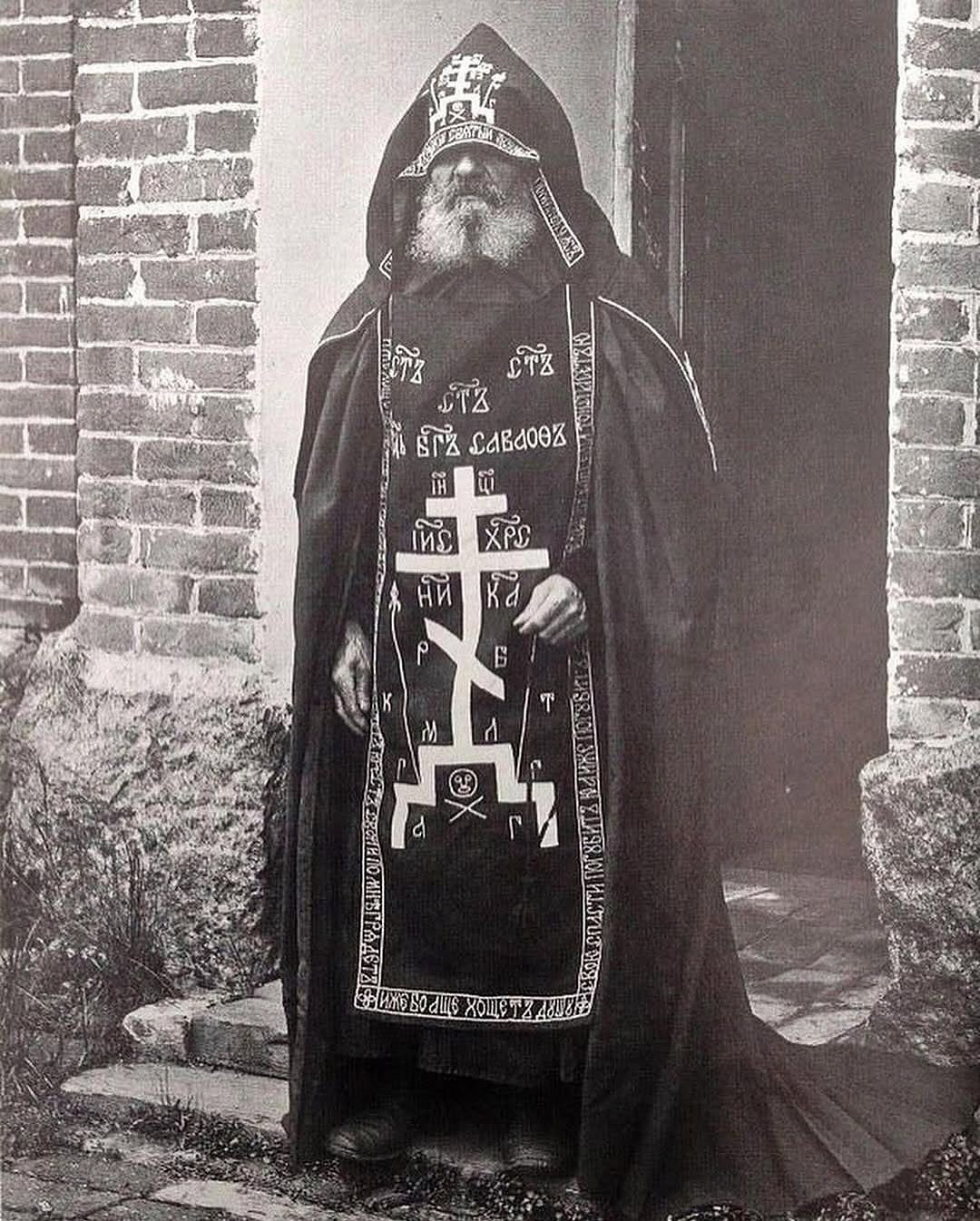
- Schema Monk Attire
The entirety of the Great Schema Order, in its practices, concepts and ideas, is laid on the Great Schema Habit itself, the outfit worn by the schemamonks.
Where applicable (which is most), the pagan origin of the symbol or element will be shown.
Where applicable, the metaphysical effect and logical conclusion of the symbol or element will be showcased.
The black color of the habit - Greco-Roman and Near-Eastern traditions had black outfits to signify the alchemical Nigredo. Here, it means perpetual repentance, death to world.
Long cassock - priestly/ritual robes in Mediterranean cults had these features. Here, it is meant to hide the body and the individual identity.
Wide outer cassock sleeves - ceremonial robes in Hellenistic and Persian courts had this as a sign of status. Here, they make practical life harder to signify the "angelic" nature of the monk.
Monastic belt - warrior and initiatory girdles in Greco-Roman cults of Mithras did have ornate spiritually symbolic belts. Here, it is, sorry to say, basically a chastity cage in meaning.
Mantle cloak - philosophical cloaks of Cynics and Stoics were almost identical, a visible renunciation of luxury.
Paraman back square - literally directly an element of the Egyptian High Priest's outfit. Here, the burden of Christ and a yoke (self-admitted).
Cross-shaped cords - ritual binding cords in mystery cult initiations to drive attention via sensation to certain energy pathways. Here, it is bondage to God, obedience and loss of self-will (admitted).
Central cross symbol - ToZ has deeply shown that the cross is inherently pre-christian, and shows the structure of the soul.
Skull imagery - themes of "memento mori" are ubiquitous in pagan traditions, and the skull is a direct Orphic symbol. Here, the skull is Adam's skull. "Corrupted human nature" has been overtaken by "Christ's victory". "We have all been remade by Jesus", it speaks for itself.
Spear symbol - the spear is a weapon wielded by many Gods. It signifies the power of that God and Their associated energies to pierce through obstacles in the soul and the life path. Here, it is the lance of Christ’s passion, a piercing of the sacrifice that is Jesus, not dissimilar to sacrificial rites in ancient Judaism, and modern Halal sacrifice.
Sponge on reed - Offerings were placed on reed in Ancient Egypt. Here, the sponge that mockingly gave bitter liquid to Jesus, element of the passions, which mirror the self-inflicted suffering of the monk.
Ladder of ascent - Ubiquitous. Egypt had a stairway to heaven as well, Mesopotamia had the Ziggurat, many Greek mystery cults had it.
Nails symbol - Nails signify binding in many ancient ceremonial magick systems.
Crown of thorns - Thorn crowns were present in fertility cults throughout Greece.
Angelic wing motifs - Ubiquitous, from winged psychopomps in almost every pantheon, to the angelic beings themselves existing in various Near-Eastern faiths, and more.
Veil (koukoulion) - matches perfectly the Veil of Isis for the Egyptian priesthood.
Covered head garment - Ubiquitous in pagan faiths, thoroughly documented.
Prayer rope - Knotted cords or beaded ropes were present in Greco-Roman and Indian traditions.
On the robe itself, are written afirmations and textual symbols:
IC XC NIKA - Iesous Christos Nika (Jesus Christ triumphs)
IC XC - Iesous Christos (Jesus Christ)
NIKA - Triumphs
INBI / INRI - “Jesus of Nazareth, King of the Judeans"
MP ΘΥ - “Mother of God”
Ὁ ὬΝ - “The One Who Is”
“Holy God, Holy Mighty, Holy Immortal”
“Holy, Holy, Holy”
“The Cross is the guardian of the whole world”
“We bow to Your Cross, O Master”
“I bear in my body the marks of the Lord Jesus”
“Take up your cross and follow Me”
“He who does not take up his cross is not worthy of Me”
“Glory to God in the highest”
“Jesus Christ, Son of God, have mercy on me”
“God is with us”
“O Lord, remember me in Your Kingdom”
“The Lord is my light and my salvation”
“Blessed is He who comes in the name of the Lord”
“Glory to the Father, and to the Son, and to the Holy Spirit”
“Now and ever and unto ages of ages”
“May God arise and His enemies be scattered”
“The Lord has reigned”
“Save me, O Lord”
“Have mercy on me”
“O God, cleanse me a sinner”
“Remember death”
“The fear of the Lord is the beginning of wisdom”
“My soul magnifies the Lord”
“The Lord is my shepherd”
“Let everything that breathes praise the Lord”
“Worthy is the Lamb”
“Christ is risen”
“Blessed are the pure in heart”
“The Kingdom of Heaven is within you”
“I am the Way, the Truth, and the Life”
“No one comes to the Father except through Me”
“Be vigilant and pray”
“Pray without ceasing”
Removal of vowels ("nomine sacri" as a christian practice) is present in systems of magick in Greece.
The symbolism of Jesus was shown to be of pagan origin almost wholesale by Temple of Zeus, from Orphic shepherd themes to Solar cult elements. Jesus as a "sacrifice of atonement" has also been shown to have dark, occult connotations that affect both psychologically and spiritually the perspective the believer has on human nature.
The symbolism of Mary was equally shown to be present almost word for word on many Greek and Egyptian Goddesses.
The rest is self-hating, self-guilting ideas.
BIBLIOGRAPY:
The Great Euchologion (Trebnik): Rite of Tonsure into the Great Schema
The Horologion
The Typikon: Monastic Rule and Liturgical Order
The Ladder of Divine Ascent, John Climacus.
The Sayings of the Desert Fathers (Apophthegmata Patrum).
Dark Night of the Soul, John of the Cross
I was studying some Eastern Orthodox material to point out symbolism and doctrine that already existed within ancient religions, and ended up making this an entire essay about the Schema Monk order, its practices, its symbolism and its history. This essay describes the monk order and fully exposes the problems with it, the symptoms of Yehuboric influence as well as the symbolic theft. It is rightfully called theft because, unlike other ancient religions which did engage in syncretism and development, christian sects take these concepts, use them, and then claim that they invented them or that theirs are the only sacred ones, while calling the sources of these symbols evil and demonic.
This essay might or might not become a series. If it does, the next "priesthood" I will discuss in an essay will be a historical analysis of Buddhism, as well as how many of the schools of thought that developed which show Yehuboric characteristics.
There will also be a parallel series detailing the operations and mysteries (what we know) of various Priesthoods and orders that align with Zevism. When an essay about those comes out, I will drop it in a reply to this post.
The "Great Schema" Monastic Order
The Great Schema (Greek: Μεγάλο Σχήμα, Megalo Schema) represents the most radical form of monastic commitment within the Eastern Orthodox Church. The term schema itself means “form" or “state”, representing a state of being for the Orthodox faithful. The imagery that this order uses is that of the "living martyr", someone that has "died and been reborn", similar to groups like the Orphic Mystery School. What this article will expose is that, spiritually, the "death" is certainly there, but I am yet to discover the "rebirth".
At its core, the Great Schema is understood as the culmination of the monastic path: a life that seeks the death of "worldly identity" and embodiment of what is described as an “angelic state" (elaboration later). The schemamonk is a practitioner of asceticism, and an "icon" of the "eschatological (Eschaton - post-end-of-the-world existence) reality" of Orthodoxy, and the logical conclusion to the path that christianity lays out.
Historical Emergence and Eastern Monasticism
The roots of the Great Schema lie in the early centuries of christian monasticism, particularly in the ascetic movements of the Egyptian and Syrian deserts during the 3rd and 4th centuries, also known as the "Desert Fathers" (quite an ironic and accurate name, if I'm allowed some derision). These early monks, driven by a desire for devotion and renunciation of the world, withdrew from society to pursue lives of solitude, prayer, and extreme "discipline". Nothing new under the Sun, and deeply criticized by Zevism, but the rabbit hole goes deeper.
Figures such as Anthony the Great are often seen as foundational to the Schema, though the formal category of the Great Schema did not yet exist. Instead, what emerged was a varied spectrum of ascetical intensity. Over time, as monastic life became more structured, especially through communal (cenobitic) systems, the need arose to formally distinguish between varying degrees of commitment.
Monasticism gradually evolved into a tiered system, particularly within Byzantine practice. Typically, this included stages such as the novice (postulant), the rassophoros (robe bearer), the stavrophoros (cross bearer), and finally, the Great Schema. We will lightly touch on the symbolism of the others, but for the most part, looking at the Great Schema as the logical conclusion will showcase all the dirt we need to see, because the progression is an intensification, not a change.
The Great Schema is often offered as a title and role only for monks at the end-stages of their life, as it requires certain "spiritual" (I suppose, while not beneficial, they indeed are of spiritual nature) processes.
The spiritual DNA of the Great Schema is most clearly visible in the lives and ideas of the Desert Fathers. These early ascetics established the core principles that would later define schemic life: radical detachment from the world, poverty, interior vigilance against "temptation", unceasing prayer, and the systematic killing of individuality within the soul.
Practices of the Schemamonk from a Zevist perspective
The ascetic routine of the schemamonk is incredibly strict, and allows for very little rest, healthy habits or enjoyment.
Midnight prayers or nighttime prayers are common, most schemamonks sleeping in interrupted chunks. Aside of manual labor and basic bodily needs (which themselves are not very thoroughly taken care of, as intense fasts are almost constantly taken), the entirety of wakeful time is spent in prayer.
This includes:
- "prayer of the Heart", where the goal is to eliminate the rational faculties, and to "descend the mind into the heart", focusing entirely on strong emotion to worship "God"
- prayers for forgiveness, for blessing the church, for driving more individuals into the church, all done with intense mental focus
- the Jesus prayer ("Lord Jesus Christ, have mercy on me, a sinner"), repeated mentally or aloud as a mantra, for hours a day every day
- Biblical study, endless reading and re-reading of bible passages, especially Psalms blessing and praising the "God" of Israel (truly, just a false notion and an impostor theology that overtook the ancient polytheistic worship of the people)
No words are necessary here to understand why this self-flagellating lifestyle, although self inflicted, has wholly negative spiritual repercussions, and is a denial of life itself, which any devoted Orthodox will actually admit and be proud of.
"Death of the individual soul" in the Great Schema
In Orthodox theology, the human person is claimed to be transfigured into the living embodiment of the will of "God" and a vessel for its energies.
From the experiential perspective of the schemamonk, this process is a form of death, specifically, the death of the autonomous, self-directed ego that defines itself through desires, attachments, and personal will.
Metaphysically, this aligns with the concept of kenosis (emptying, practiced in far less destructive ways in many Ancient Greek rites). The individual relinquishes all claims to independence in order to be fully oriented toward divine reality. In lived practice, this “death” is enacted through constant "repentance", gradually dismantling the structures that sustain the sense of a separate, self-sufficient identity. The monk no longer lives “for himself” but becomes a transparent vessel through which "divine" will operates. This is why the Great Schema is often associated with burial imagery: the garments resemble a shroud, the vows are treated as a final commitment, and the life itself is seen as preparation for death and itself a death.
Schemamonks are called
- "living martyrs"
- "crucified alongside Jesus"
- "like angels in life", existing only to adore "God"
While the work "Dark Night of the Soul" is unrelated to the Great Schema order and stems from Western christian philosophy, the general idea described therein of how christian practices first kill, then realign with the agenda of the christian "God" the intellectual faculties first, then the sense faculties and desires, then the individual soul itself, is very poignant here.
Through prayer, intense focus on themes of guilt and repentance, denial of the flesh and denial of individuality, denial of talent and worthiness as well as of power, the process of "theosis" occurs. First, the intellectual faculties give in, and are fully aligned towards the goal. The mind no longer denies "God". Then, the emotions and desires are systematically destroyed by renunciation. Finally, the individual soul itself is "crucified" and what remains is a vessel, a hollow husk. None of this is "polemic", it is the direct language and imagery that the order itself proudly showcases.
Why do I say I found death, but did not find rebirth?
In Pagan faiths, the Gods embody and govern aspects of life, and progress in Theurgy makes one like an avatar of certain powers, tasting more of the feast of life and in a more proper way, receiving more life and more personhood, more identity, more sovereignty, more knowledge.
The christian God, on the other hand, is a God of "everything and nothing". It claims the qualities of Zeus, but does not hold to the polytheistic, Henadic flow that gives Zeus a coherent meaning.
There is no expansion of complexity, like a blooming flower, which we see in Apotheosis and in pagan theologies. Zeus' all encompassing divinity is much like a seed in a certain way, while the bloomed flower with its beauty and complexity is a principle of expansion that is seen in the Gods themselves, all sovereign identities while still of the same divine essence of being.
In Orthodoxy and general christendom, God only acts as the seed, and only the seed is divine. The flower is the created world, which is binarily separated from the divine through a perspective that sees anthropology and nature as fallen, with only a vague promise of reconciliation with the Divine.
This promise is hollow, though, and this is evident in the Great Schema order. We do not see a glorious deified human that went through "theosis". We do not see reconciliation of the human nature and the material with God. We see a renunciation of the fallen material and the fallen human nature. The "broken machine" as christianity claims it to be, was not fixed, but rather taken out of commission.
If we strip away all the theological pretense taken directly from Greek schools of thought about the divine, the God of christianity, from this perspective, reveals itself to be a God of nothingness.
The individual will of the monk orients oneself towards nothingness, dwells on nothingness, embraces nothingness, becomes nothingness and perpetuates nothingness.
Symbolism of the Great Schema - Decoding, Origins Revealed
- Schema Monk Attire
The entirety of the Great Schema Order, in its practices, concepts and ideas, is laid on the Great Schema Habit itself, the outfit worn by the schemamonks.
Where applicable (which is most), the pagan origin of the symbol or element will be shown.
Where applicable, the metaphysical effect and logical conclusion of the symbol or element will be showcased.
The black color of the habit - Greco-Roman and Near-Eastern traditions had black outfits to signify the alchemical Nigredo. Here, it means perpetual repentance, death to world.
Long cassock - priestly/ritual robes in Mediterranean cults had these features. Here, it is meant to hide the body and the individual identity.
Wide outer cassock sleeves - ceremonial robes in Hellenistic and Persian courts had this as a sign of status. Here, they make practical life harder to signify the "angelic" nature of the monk.
Monastic belt - warrior and initiatory girdles in Greco-Roman cults of Mithras did have ornate spiritually symbolic belts. Here, it is, sorry to say, basically a chastity cage in meaning.
Mantle cloak - philosophical cloaks of Cynics and Stoics were almost identical, a visible renunciation of luxury.
Paraman back square - literally directly an element of the Egyptian High Priest's outfit. Here, the burden of Christ and a yoke (self-admitted).
Cross-shaped cords - ritual binding cords in mystery cult initiations to drive attention via sensation to certain energy pathways. Here, it is bondage to God, obedience and loss of self-will (admitted).
Central cross symbol - ToZ has deeply shown that the cross is inherently pre-christian, and shows the structure of the soul.
Skull imagery - themes of "memento mori" are ubiquitous in pagan traditions, and the skull is a direct Orphic symbol. Here, the skull is Adam's skull. "Corrupted human nature" has been overtaken by "Christ's victory". "We have all been remade by Jesus", it speaks for itself.
Spear symbol - the spear is a weapon wielded by many Gods. It signifies the power of that God and Their associated energies to pierce through obstacles in the soul and the life path. Here, it is the lance of Christ’s passion, a piercing of the sacrifice that is Jesus, not dissimilar to sacrificial rites in ancient Judaism, and modern Halal sacrifice.
Sponge on reed - Offerings were placed on reed in Ancient Egypt. Here, the sponge that mockingly gave bitter liquid to Jesus, element of the passions, which mirror the self-inflicted suffering of the monk.
Ladder of ascent - Ubiquitous. Egypt had a stairway to heaven as well, Mesopotamia had the Ziggurat, many Greek mystery cults had it.
Nails symbol - Nails signify binding in many ancient ceremonial magick systems.
Crown of thorns - Thorn crowns were present in fertility cults throughout Greece.
Angelic wing motifs - Ubiquitous, from winged psychopomps in almost every pantheon, to the angelic beings themselves existing in various Near-Eastern faiths, and more.
Veil (koukoulion) - matches perfectly the Veil of Isis for the Egyptian priesthood.
Covered head garment - Ubiquitous in pagan faiths, thoroughly documented.
Prayer rope - Knotted cords or beaded ropes were present in Greco-Roman and Indian traditions.
On the robe itself, are written afirmations and textual symbols:
IC XC NIKA - Iesous Christos Nika (Jesus Christ triumphs)
IC XC - Iesous Christos (Jesus Christ)
NIKA - Triumphs
INBI / INRI - “Jesus of Nazareth, King of the Judeans"
MP ΘΥ - “Mother of God”
Ὁ ὬΝ - “The One Who Is”
“Holy God, Holy Mighty, Holy Immortal”
“Holy, Holy, Holy”
“The Cross is the guardian of the whole world”
“We bow to Your Cross, O Master”
“I bear in my body the marks of the Lord Jesus”
“Take up your cross and follow Me”
“He who does not take up his cross is not worthy of Me”
“Glory to God in the highest”
“Jesus Christ, Son of God, have mercy on me”
“God is with us”
“O Lord, remember me in Your Kingdom”
“The Lord is my light and my salvation”
“Blessed is He who comes in the name of the Lord”
“Glory to the Father, and to the Son, and to the Holy Spirit”
“Now and ever and unto ages of ages”
“May God arise and His enemies be scattered”
“The Lord has reigned”
“Save me, O Lord”
“Have mercy on me”
“O God, cleanse me a sinner”
“Remember death”
“The fear of the Lord is the beginning of wisdom”
“My soul magnifies the Lord”
“The Lord is my shepherd”
“Let everything that breathes praise the Lord”
“Worthy is the Lamb”
“Christ is risen”
“Blessed are the pure in heart”
“The Kingdom of Heaven is within you”
“I am the Way, the Truth, and the Life”
“No one comes to the Father except through Me”
“Be vigilant and pray”
“Pray without ceasing”
Removal of vowels ("nomine sacri" as a christian practice) is present in systems of magick in Greece.
The symbolism of Jesus was shown to be of pagan origin almost wholesale by Temple of Zeus, from Orphic shepherd themes to Solar cult elements. Jesus as a "sacrifice of atonement" has also been shown to have dark, occult connotations that affect both psychologically and spiritually the perspective the believer has on human nature.
The symbolism of Mary was equally shown to be present almost word for word on many Greek and Egyptian Goddesses.
The rest is self-hating, self-guilting ideas.
BIBLIOGRAPY:
The Great Euchologion (Trebnik): Rite of Tonsure into the Great Schema
The Horologion
The Typikon: Monastic Rule and Liturgical Order
The Ladder of Divine Ascent, John Climacus.
The Sayings of the Desert Fathers (Apophthegmata Patrum).
Dark Night of the Soul, John of the Cross


