
Temple of Zeus — The Assembly of the Gods

How to Search Like a Medical Researcher: From Basics to PubMed

Kuka

KukaActive Translator
#1

Greetings, Family.

This guide was born out of a very specific rabbit hole: tracking down a citation for HPS Lydia's reply about a Canadian circumcision study that had since gone offline. Something about that hunt — ten-plus browser windows, cross-referencing databases, chasing a source that kept slipping away — woke up something in me. I genuinely enjoyed it. Then I remembered: this is actually something I know how to do, from a very niche job I held four years ago.

Brother Black Magic's article on how casinos works gave me the idea to put this into writing, and Sister Astrid encouraged me to actually do it — so thank you both.

The reason I think this belongs here, on this forum, goes beyond general curiosity. If you are supporting a healing working for someone, or helping a loved one navigate a diagnosis, knowing how to read the actual research can make a real difference. It helps you walk into a GP appointment without getting stuck in a back-and-forth loop — you come prepared, you ask better questions, and the conversation moves forward.

Whether you are dealing with a new diagnosis, simply curious about health, or a student hunting for clinical data, Googling health information can be overwhelming and unreliable. This guide gives you a step-by-step roadmap to find trusted information — starting with plain English and ending with professional clinical data.

A bit about me: I spent a year working at a scientific library for an oncological research institute. I managed references across more than 30 medical units, tracked around 550+ peer-reviewed publications, and built personalized research strategy for both physicians and patients. It is a very niche background, but it turns out to be genuinely useful.

To show you how this works, I will use HER2 Breast Cancer as a running example across all four platforms — it was simply the first condition that came to mind. Every step works exactly the same way for any other condition you might need to research


1. MedlinePlus — The Trusted Starting Line Best for: General information, patients, and non-healthcare. avaiable in english and spanish

Before you look anywhere else, start here. Think of MedlinePlus as a government-referenced Wikipedia, but completely written and vetted by physicians. Run by the National Library of Medicine, it strips away confusing jargon and gives you the facts without trying to sell you a miracle cure.

Our Example: Search for Breast Cancer (keep it broad at this stage — you are building vocabulary, not diving deep yet). You will get a clean topic page that covers the basics: what it is, how it is diagnosed, how it is treated. Notice the left-hand sidebar menu — it breaks the topic into sections like Types, Diagnosis, Treatment, and Survival Rates. Work through those before moving on. By the end you will have the foundational vocabulary needed for every step that follows.
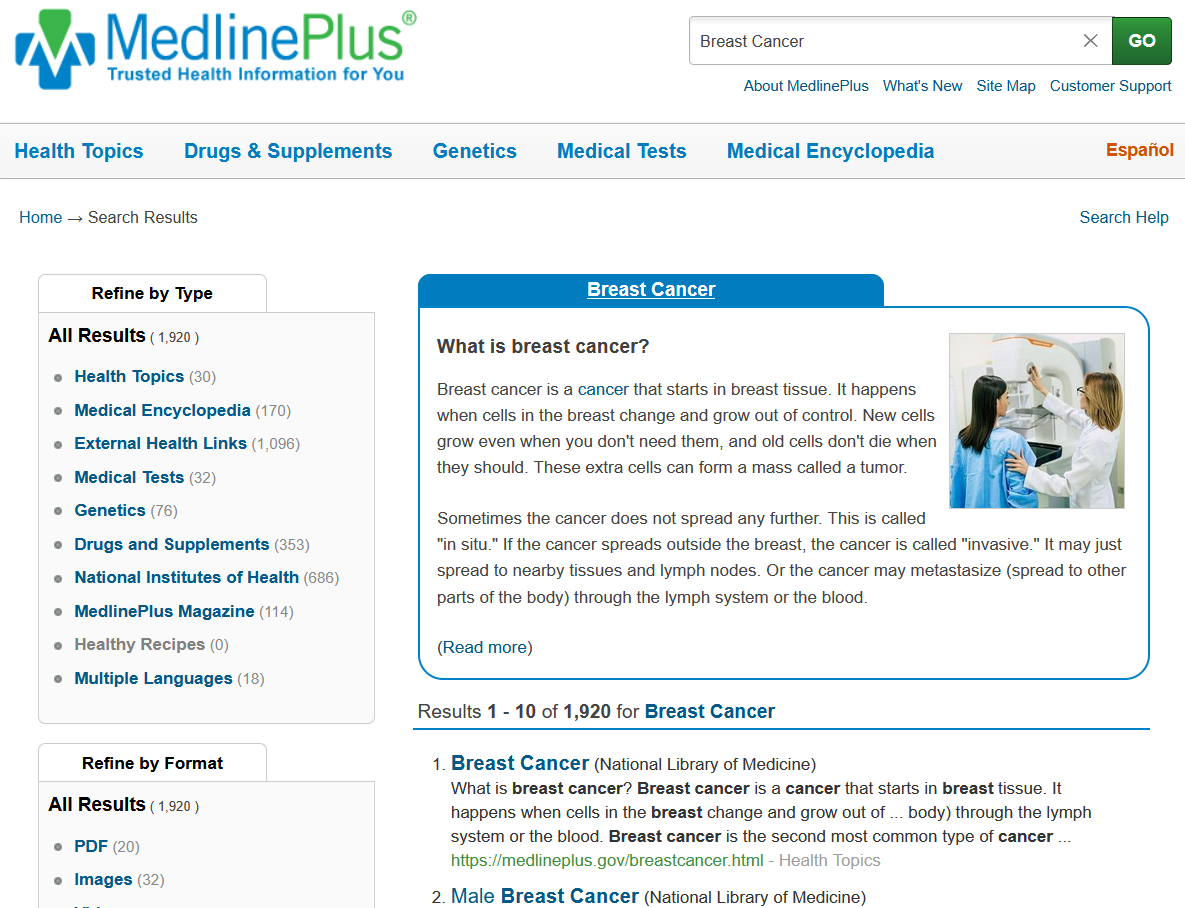
🔗 https://vsearch.nlm.nih.gov/vivisimo/cgi-bin/query-meta?v%3Aproject=medlineplus&v%3Asources=medlineplus-bundle&query=Breast+CancerExternal ↗

1775952171069.png
Open 1775952171069.png · 219 KB

2. Cancer.gov — The Layered ResourceBest for: Bridging the gap between the general public and biomedical professionals.

While MedlinePlus will often link out to Cancer.gov, this site deserves its own standalone mention. Run by the National Cancer Institute, it is also available in Spanish — useful if you are searching for someone whose first language is not English.

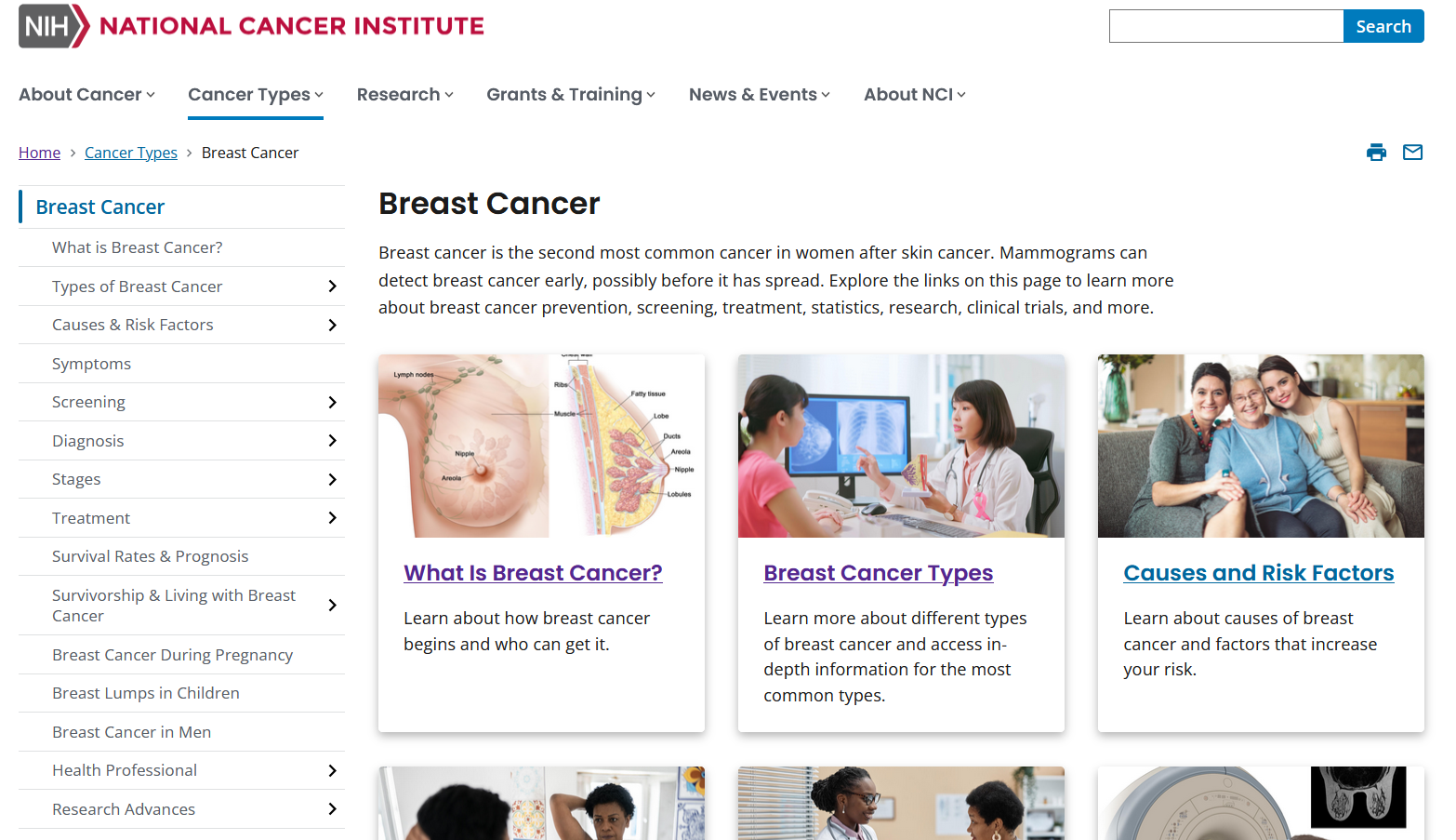
Our Example: Go to the Breast Cancer section 🔗 https://www.cancer.gov/types/breastExternal ↗ and look at the left-hand sidebar. What used to be a simple toggle between patient and professional content has since been reorganised into a full sidebar menu. You will see a dedicated Health Professional section — it sits alongside the patient-facing content rather than overlapping it. Click into it and you get the same topics (treatment, staging, screening) but written at a clinical level: cellular pathways, monoclonal antibody mechanisms, survival statistics. Same site, very different depth.
1775952143115.png
Open 1775952143115.png · 726 KB

3. Google — Filtering Out the NoiseBest for: Finding local guidelines, nearby clinics, and searching in your native language.

MedlinePlus and PubMed are heavily English-centric. Once you understand your topic, you can use Google to search further in your own language — but you need basic "Boolean logic" so Google does not feed you commercial junk.

  • AND / OR logic: Google automatically puts an AND between words (narrowing the search). If you want synonyms, use a capitalized OR — e.g., "HER2-Low" OR "HER2-Positive".

  • The minus sign ( - ): Google's version of NOT. Use it to ban words from results.

  • The site filter: Add site:.gov (or your country's equivalent — site:.it for Italy, site:.edu for universities).

Our Example (HER2 Google String):"HER2-Low" OR "HER2-Positive" "Breast Cancer" targeted therapy site:.gov or any official site in your conuntry,

This forces Google to look only at official organizational guidelines and ignores SEO-optimized blogs.


4. PubMed — The Deep EndBest for: Biomedical students and finding raw peer-reviewed studies.

This is the ultimate database of academic literature. Unlike Google, PubMed uses specific tags and the capitalized word NOT to exclude terms. To do a highly targeted search, you use MeSH (Medical Subject Headings — PubMed's official dictionary) and Entry Terms (accepted synonyms).

The Pro Strategy: How to Build a Mega-String Fast

  1. Find an anchor article — one article you really like on PubMed (e.g., HER2-Low Breast Cancer: Now and in the Future). https://pubmed.ncbi.nlm.nih.gov/38291745/External ↗

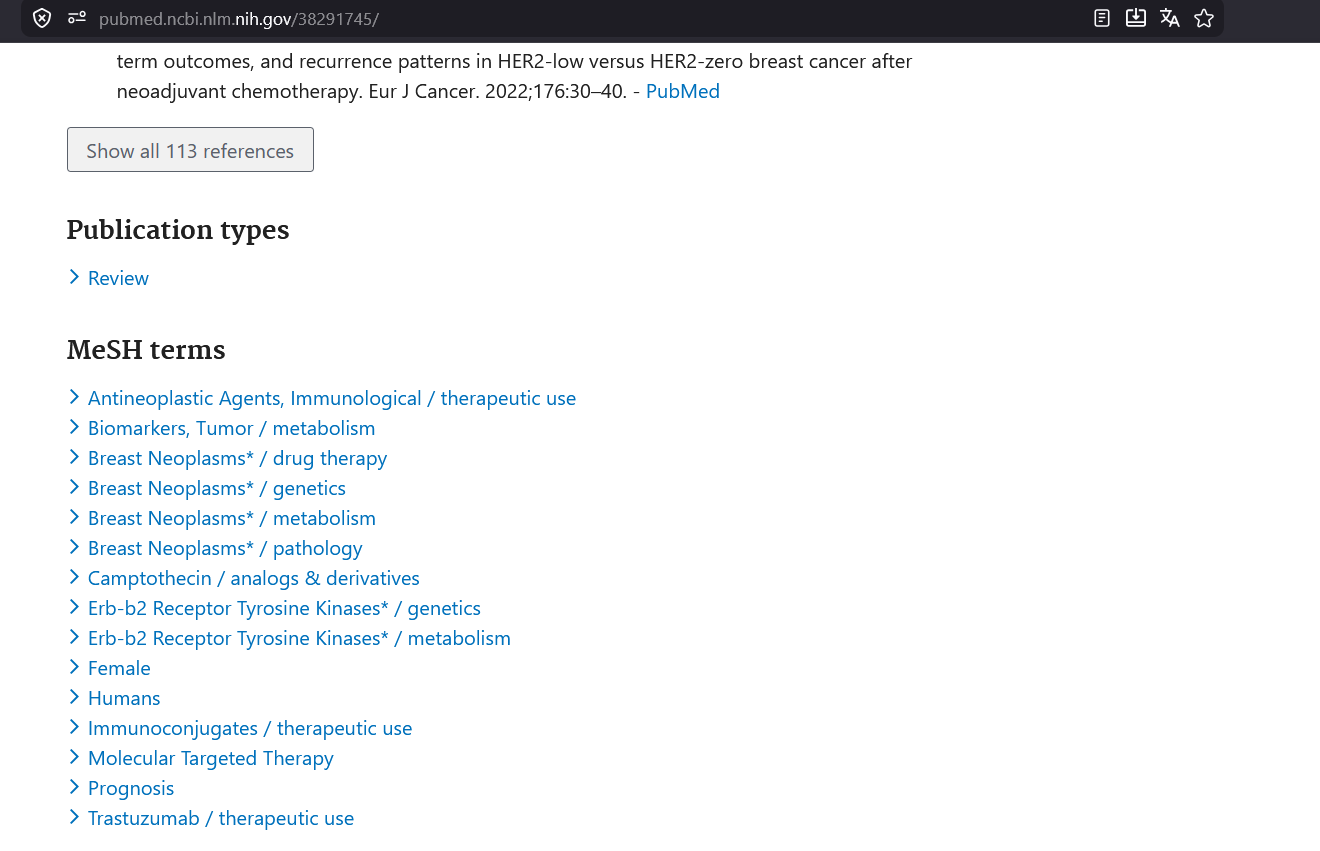
  2. Scroll to the bottom — look below the citations for the "MeSH terms" section.

    1775952415589.png
    Open 1775952415589.png · 112 KB
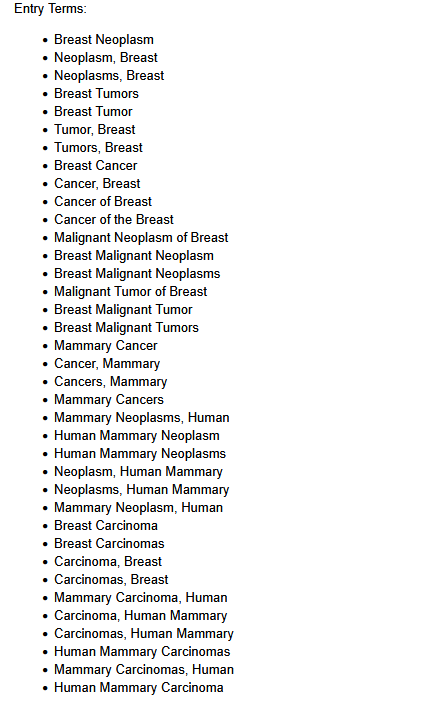
  3. Open the MeSH Database — click a relevant term (e.g., Antineoplastic Agents, Immunological) to see all associated synonyms (Entry Terms). https://www.ncbi.nlm.nih.gov/mesh/2023292External ↗ and
    https://www.ncbi.nlm.nih.gov/mesh/68001943External ↗ (those are the mesh terms)

    1775952563702.png
    Open 1775952563702.png · 62 KB
    1775952773308.png
    Open 1775952773308.png · 33 KB

    those are the entry terms, which research on the topics uses it's also associated by editors onto the Mesh terms on Thesaurus, also they let you see novel research un-indexed by using those terms commonly referred as keywords

  4. Use AI to build your string — ask an AI to build a search block using the [Mesh] tag for the main term and [tiab] (Title/Abstract) for the entry terms. Use * to catch plurals — Antibod* catches both Antibody and Antibodies. this is the trick instead of copying and getting mad on advanced search, Ai can do the heavy lift here.

  5. Combine with AND — wrap your blocks in parentheses and connect concepts with AND. between the Mesh terms, as below you'll see i searched for Antineoplastic Agents, Immunological as mesh, the OR terms are the entry terms combined with
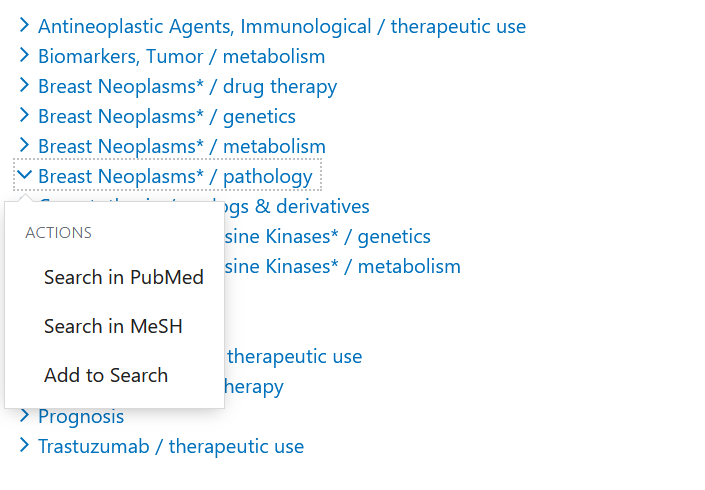
Our Example (HER2 PubMed String):

(("Antineoplastic Agents, Immunological"[Mesh] OR "Immunological Antineoplastic Agent*"[Title/Abstract] OR "Antineoplastics, Monoclonal Antibod*"[Title/Abstract] OR "Monoclonal Antibod*, Antineoplastic"[Title/Abstract] OR "Antineoplastic MAb*"[Title/Abstract]) AND ("Breast Neoplasms"[Mesh] OR "Breast Neoplasm*"[Title/Abstract] OR "Breast Tumor*"[Title/Abstract] OR "Breast Cancer*"[Title/Abstract] OR "Breast Malignant Neoplasm*"[Title/Abstract] OR "Mammary Carcinoma*, Human"[Title/Abstract]))

Paste that string directly into the main PubMed search bar. You instantly have a high-quality, ultra-specific literature search on immunological treatments for HER2 breast cancer — one that would normally take 10 minutes at least to build it.

A Note on Wisdom and Its Limits

Knowledge is a gift and a responsibility — use it to become a more informed, empowered person. But even the deepest research is not a substitute for direct guidance from someone who can truly see your situation. Whatever you find in these databases, bring it to a qualified physician or oncologist and let it become the beginning of a conversation, not the end of one.

I hope this will help someone 🙏

Discussion

#2

Thats the grueling foundation of medical reseaechers, going through these boring databases. You dont want to reinvent the wheel so to say, going through rigorous studies only to find out a team in japan did the same 5 years ago. But the future of medical research and more specifically oncology (nuclear medicine) is in the hands of chemists and physicists, not physicians. If you really want to be "kvlt" go into these fields, as medical degrees do not prepare to be at the vanguard of areas like nano medicine, which is what will ultimately solve cancer.

KukaActive Translator
#3

That's just the surface of it — I didn't even touch Scopus or Embase, which overlap with Medline (PubMed) about 99.99% of the time anyway, or Web of Science, or the Journal Citation Reports. The bibliometric side deserves its own mention: Impact Factors carry real weight, since how many high-IF publications a unit produces is often a decisive factor in how much funding it receives.

The truly gruesome pressure underneath all of it is Publish or Perish — well known across academia, not just medicine. It's actually one of the reasons systems like MeSH exist in biomedical databases: standardized indexing ensures as many articles as possible get found, regardless of how authors phrased their terms.

And the timeline from a novel idea to a Phase III clinical trial is almost incomprehensible — and that's before you factor in cost. What you described — avoiding reinventing the wheel by searching the literature — is exactly how it works in practice. A literature search across a topic produces a Review; pulling several of those together produces a Systematic Review, which is distilled, non-novel research: the clearest possible map of what's already known.

Oncology makes that map enormous by necessity. It touches immunology, stem cell biology, genetics, pharmacology — essentially the full scope of biomedical knowledge. Abnormal cell growth doesn't respect specialty boundaries, which is exactly why understanding it demands all of them.

MT KimActive Translator
#4

Thank you so much!! Bookmarked, I'm going through my pre-reqs right now this will help me a lot

KukaActive Translator
#5
MT Kim wrote:View source

Thank you so much!! Bookmarked, I'm going through my pre-reqs right now this will help me a lot

I'm glad this guide helped you :)

KukaActive Translator
#6

Greetings Family,

I wanted to expand on my previous guide. This second and final part gets into the highly niche tools, but it represents the complete workflow for a PhD student or biomedical researcher, all in one place. I left out Web of Science and some marginal things to keep it focused.

The reason I wanted to share this is because I don't want to gatekeep anymore. This is highly specialized knowledge that usually requires access to a Librarian and at least 5 hours of boring training from different seminairs —this guide is your shortcut. Full disclosure: my university doesn't have access to Embase, so I can't walk you through its interface from scratch, but I will explain the exact syntax you need to know. Cochrane I've only used briefly; it's very PubMed-adjacent but focused on trials and reviews.

Enjoy the guide.

5. PubMed Advanced Search: Searching by Author

In the first part, we covered MeSH terms and keyword strings. But if you are tracking a specific researcher's output (or trying to find your own publications for an ORCID sync), you need to use the Author field.

Step-by-Step:

1. Go to PubMed and click Advanced Search.

2. In the builder dropdown menu, select Author.

3. Type the author's name using the format LastName Initials (no punctuation). Always use the full surname followed by initials — never the full first name, because PubMed indexes authors by surname + initials and will miss publications if you search any other way. To search for "John A. Smith", type: Smith JA

4. Click Add to move the term to the search box. PubMed automatically adds the [au] tag: Smith JA[au]

5. Combine with your topic: If you only want John A. Smith's papers on HER2 breast cancer, add your topic string from Part I using AND:

Smith JA[au] AND ("Antineoplastic Agents, Immunological"[Mesh] OR "Immunological Antineoplastic Agent*"[Title/Abstract])

6. Pro-tip: If the author has a very common name (e.g., "Li W"), you can add their affiliation to narrow it down. Use the [ad] (Affiliation) tag: "Harvard"[ad] AND Li W[au]

6. Embase and Emtree Terms

Embase is Elsevier's biomedical database, essential for drug research, pharmacology, and European literature. If you are doing a systematic review, you must search both PubMed and Embase. Embase uses its own controlled vocabulary called Emtree.

Since I don't have institutional access to the Embase interface, I can't give you the exact button clicks, but you must understand the syntax because any proper systematic review requires an Embase strategy.

The Syntax Rules

1. Emtree Terms (/exp): Just like MeSH, you use controlled terms. In Embase, explosion (including narrower terms) is the default. You append /exp to the Emtree term.

Example: 'breast cancer'/exp

2. Free-Text (:ti,ab,kw): You must combine Emtree with title/abstract/keyword searches to catch unindexed papers. Crucial Rule: You MUST enclose exact phrases in single quotes, or Embase pulls random disconnected words. You append :ti,ab,kw to restrict the search.

Example: 'breast cancer':ti,ab,kw OR 'breast neoplasm':ti,ab,kw

3. Combining: Combine the Emtree line and Free-text line with OR, then combine concepts with AND.

Example Strategy (HER2 Breast Cancer & Monoclonal Antibodies):

('breast cancer'/exp OR 'breast cancer':ti,ab,kw OR 'breast neoplasm':ti,ab,kw)

AND

('immunological antineoplastic agent'/exp OR 'monoclonal antibody':ti,ab,kw OR trastuzumab:ti,ab,kw)

Drug Qualifiers: Emtree allows you to append qualifiers to restrict drug searches to specific aspects. For HER2 research, searching 'trastuzumab'/exp/ae restricts the search to Adverse Effects (ae). Other common qualifiers include dt (drug therapy), pk (pharmacokinetics), and ch (chemistry).

7. The Cochrane Library for Systematic Reviews

Cochrane is the gold standard for clinical trials and systematic reviews. It uses MeSH terms exactly like PubMed, but the search interface is entirely different. Do not use the basic search bar—always use the Search Manager.

Step-by-Step:

1. Go to cochranelibrary.comExternal ↗ and click Advanced Search, then the Search Manager tab.

2. Add MeSH: Click the MeSH button next to line #1. Look up Breast Neoplasms, check "Explode all trees," and click Add to Search Manager. Line #1 reads:

#1 MeSH descriptor: [Breast Neoplasms] explode all trees

3. Add Free-Text: On line #2, type your keywords restricted to Title/Abstract/Keywords. Crucial Rule: You MUST use parentheses to apply the suffix to the whole phrase.

("breast cancer" OR "breast neoplasm"):ti,ab,kw

4. Combine Concept 1: On line #3, type #1 OR #2.

5. Second Concept: Repeat for the treatment. MeSH: [Antineoplastic Agents, Immunological]. Free-text: ("monoclonal antibodies" OR "immunological antineoplastic agents"):ti,ab,kw. Combine with OR (e.g., #4 OR #5).

6. Final Step: Combine the two concepts with AND (e.g., #3 AND #6). Click Go.

4. Journal Metrics: JCR, Impact Factor, and Quartiles

When evaluating where to publish or assessing a journal's weight, use Journal Citation Reports (JCR).

Step-by-Step:

1. Go to jcr.clarivate.comExternal ↗ (log in via your institution).

2. Search by Journal Name or ISSN.

What is ISSN? It's the permanent 8-digit identifier for a journal (e.g., Journal of Clinical Oncology is 0732-183X). Journal names change; ISSNs do not. Always use the ISSN for accuracy.

3. Click on the journal profile.

4. Journal Impact Factor (JIF): Calculated by dividing citations in the current year to articles published in the previous two years, by the number of citable items in those two years.

5. Quartile: Scroll down to "Rank". JCR assigns the journal to subject categories (e.g., "Oncology"). It ranks them and divides them into quartiles: Q1 (top 25%), Q2 (25–50%), Q3 (50–75%), Q4 (bottom 25%). A journal can be Q1 in one category and Q2 in another.

8. Scopus and the H-Index

Scopus is Elsevier's massive citation database, used primarily for tracking author metrics and citation counts.

Step-by-Step:

1. Go to scopus.comExternal ↗ and click the Authors search tab.

2. Search for yourself by last name, initials, and affiliation (or ORCID).

3. Crucial: Check for duplicate profiles. If Scopus split your work across two profiles, click "Request to merge authors" on the right sidebar to fix this.

4. Click your correct Author Profile. Your h-index is displayed at the top right. (Definition: An h-index of 20 means you have 20 papers cited at least 20 times each).

5. Without Self-Citations: Click "View h-graph". Check the box "Exclude author self-citations". The h-index will recalculate. Always report which version you are using.

6. To see how many times a specific document was cited, search for the document in Scopus; the "Cited by" count is listed right under the title.

9. Citation Managers: RefWorks and Zotero

If you write more than one paper, manually numbering references will lead to catastrophic errors. You need a citation manager.

RefWorks: Excellent for massive projects and deduplication across multiple databases. Requires a subscription (usually provided by your university). Install "Write-N-Cite" for Word; when writing, click "Insert Citation" and it formats automatically in AMA, Vancouver, APA, etc.

Zotero: Free, intuitive, and highly recommended. Download the desktop app and the browser connector. When looking at an article on PubMed, click the Zotero folder icon in your browser to save the metadata directly. Use the Zotero Word plugin to insert citations.

10. ORCID, Scopus Syncing, and Affiliations

ORCID gives you a unique 16-digit identifier so your publications are never confused with another researcher's. Do not just create an ORCID and leave it empty—connect it to your publication profiles.

Step-by-Step: Sync ORCID and Scopus (From ORCID)

1. Log in to orcid.orgExternal ↗.

2. Scroll down to the Works section, click Add works, then Search & link.

3. Select Scopus - Elsevier from the list and click Authorize.

4. Scopus will use your ORCID name to find your Scopus Author ID. Select your profile, confirm the papers are yours, and click Send my publication list to push them into ORCID.

Alternative (From Scopus): Go to your Scopus Author profile, click "Connect to ORCID", log in to ORCID, and authorize the link.

Critical Rule: Always write the correct affiliation.

Never abbreviate your institution's name on a manuscript. Databases use exact text to assign metrics to universities.

Correct: Department of Oncology, Faculty of Medicine, University of São Paulo, São Paulo, SP, Brazil.

Incorrect: Oncology Dept, USP.

Publish under the exact same name format every time, and add all name variants to ORCID's "Other names" section.

11. Methods for Obtaining Full Text

When you hit a paywall, use these methods in order.

Method 1: Unpaywall & Open Access Button

1. Install the Unpaywall extension and/or Open Access Button (openaccessbutton.orgExternal ↗) for Chrome/Firefox.

2. Navigate to the paywalled article. If a legally uploaded, open-access PDF exists in a repository (like PubMed Central), Unpaywall shows a green unlocked padlock on the right. Click it. The OA Button works similarly with a pop-up.

3. Note: The PDF may be the "accepted manuscript" (post-peer review, pre-formatting) rather than the final published version.

Method 2: Zotero Automated Search

1. When you click the Zotero browser connector to save an article, Zotero automatically runs a background search for an open-access PDF. If found, it attaches it instantly.

2. If it fails, right-click the citation in your Zotero library and select "Find Available PDF".

Method 3: Science Hub Mutual Aid Community

Do not confuse this with pirate sites. This is a legitimate, decentralized international document delivery network—like an international, peer-to-peer NILDE (the Italian interlibrary loan system).

1. Register on the platform.

2. Search for the article by DOI. If already shared, download it.

3. If not, submit a request. The platform operates on mutual aid credits (points): requesting an article costs points; fulfilling a request for another researcher (using your institutional access) earns you points.

4. If you have no points, small donations are accepted to support server costs or incentivize retrieval. It is pure mutual aid among researchers globally.

Method 4: Write to the Corresponding Author

Authors are legally allowed to share their papers for personal research use.

1. Find the corresponding author's email (marked with an asterisk on the article page).

2. Send a brief email:

Dear Dr. [Last Name],

I am a researcher at [Institution]. I came across your article "[Article Title]" but my library does not have access to this journal. Would you be willing to share a copy for my personal research use?

Thank you for your time.

Best regards, [Your Name]

3. Alternative: Look up the author on ResearchGate and click the "Request full-text" button on the article listing.

I Sincerely Hope this will be helpful to someone even to stimulate curiosity about this field.

1 replies
ChthoniosActive Translator
#1

Thankyou brother, this was very insightful.

KukaActive Translator
#8

Bonus post, unplanned — but here it is. I might as well share everything I picked up from this, since this knowledge sits, accumulating dust over time, given i don't know what to do with it.

It ties into my library background: I have an acquaintance who works as an editor at a well-established journal. I watched them work for a few hours, and it stuck with me. This isn't required reading, but if you're curious how a paper actually survives the gauntlet between submission and publication, here it is.

Let's say I've just finished my paper and I'm sending it off to the Journal of Bees — fictitious, of course, published by Wasp.

I hit submit. And from that moment, the manuscript isn't mine anymore. It belongs to a process I can't see.

First, it lands with the publisher. Somewhere, someone runs a first pass — does it actually fit the journal, is it serious work or noise? I have no idea who they are. I never will. All I get, eventually, is a decision.

If it clears that gate, the publisher forwards it to the journal itself — and that's where the editor enters the story.

I picture them getting it mid-shift, at some random, unglamorous hour, sandwiched between a dozen other manuscripts that all need the exact same thing mine does: attention. My paper arrives already tagged — topic, subtopic, a shortlist of potential reviewers drawn from years of reviewing history, expertise, h-index, the whole résumé of academic credibility.

And here's the part that surprised me: the editor isn't just running down a list. It's a freestyle job. They can go off-script — pull in someone from their own network, someone who reviewed a related paper last year, someone from the same institute as one of the co-authors. My fate, in part, comes down to who the editor happens to know and trust.

They pick more than two reviewers — always more than needed, because they already know what's coming. A template email goes out, polite and procedural, and then: silence, mostly. Reviewers agree to review, then vanish. They don't reply. They don't have time. This is why the editor never invites just enough people — they build in the assumption that some won't show up.

Weeks pass. This is the part nobody tells you about when you're staring at a submission portal expecting an answer in days. A reviewer is typically given a week or more just to decide whether they'll even do it. Then another week — or several — for the actual review. If they flag something, it comes back to me, and now I'm the one on the clock: fix it, respond, don't leave anything out, because if I do, it goes right back to the reviewers and the whole cycle restarts.

And somewhere in that gap, a reviewer who agreed to look at my resubmission might simply not be there anymore. Not unavailable — gone. Off the project. And the editor has to notice, has to catch it, has to quietly slot someone else in without the process ever visibly breaking.

That's the real job, I think. Not gatekeeping. Juggling. Picture someone keeping a dozen bowling pins in the air at once, and the moment one wobbles, they don't stop the act — they just reach out and catch it before anyone in the audience notices anything was ever wrong. If a reviewer disappears, move to the next name. If someone's gone quiet for two weeks, a nudge goes out. Multiply that by ten or twenty manuscripts a day, every single one of them somebody's Journal of Bees moment — somebody's years of work, waiting on a stranger's inbox.

If mine survives all of it — clears review, clears revision, clears re-review — it finally moves toward print, timed to whatever the publication schedule allows. Months, sometimes, after I first hit submit.

I never worked in that office. I sat there for a few hours, watching someone else's ordinary Tuesday, and it looked like nothing — an inbox, a spreadsheet, some template emails. But underneath that was the entire machinery deciding whether work like mine ever sees daylight.

Hopefully this is useful to anyone curious about academic research and what actually happens on the other side of "under review."

2 replies
#1

This is so interesting!! I knew someone who was published regularly and knowing more about what the process is like makes me appreciate that more. It makes sense that some things might be 'buried' because of human error and bureaucracy.

KukaActive Translator
#2
Astrid [NG] wrote:View source

This is so interesting!! I knew someone who was published regularly and knowing more about what the process is like makes me appreciate that more. It makes sense that some things might be 'buried' because of human error and bureaucracy.

Absolutely i do agree with last sentence, bureaucracy presence is strongly felt when it comes to funding as well, being said it's basically all human process in all things.

Publish or perish doesn't help, some journals defined as predatory don't either, it's a messed up thing as for my opinion.

I'm glad you felt that useful NG Astrid