Temple of Zeus — The Assembly of the Gods

New God Rituals: Raum & Asclepius

High Priest Zevios Metathronos

High Priest Zevios Metathronos
#1

Greetings everyone,

After our recent small schedule, below you will find the new Rituals. After the conclusion of the days of the Schedule, these are to be done for 3 consecutive days. Asclepius is a new God that is introduced to the Temple of Zeus [God of Healing, he became a God] and is a well known God for his healing capacities and amazing abilities.

Raum is known as Khnum and his powers are related to the creation, maintenance and source of all life in existence. Both the Rituals are going to be amazing, so do participate. Below are the links to the Rituals.

More things upcoming soon:

Raum Power Ritual: https://tozrituals.org/ritual/demon/khnum-power-ritual.htmlExternal ↗
Asclepius Power Ritual: https://tozrituals.org/ritual/demon/asclepius-power-ritual.htmlExternal ↗

-High Priest Zevios Metathronos

Discussion

#61

I would like to add something here about Imhotep, why I favor him over Asclepios. Jamieson Boyd Hurry put it perfectly in the words:

„Strange it is that the claims of Imhotep to be recognized as the tutelary deity of medicine have been so neglected … long before the recognition of Asklepios by the Greeks as their legendary god of medicine: long before the days of Homer: long before the birth of Hippocrates, there lived in Egypt a magician-physician so famous for his skill in healing disease that he became recognized eventually as the Egyptian god of medicine. To him surely belongs the highest place in our hagiology; to him should physicians all the world over look up as the patron spirit of the ars medendi (Note from me: the medical art), as the emblematic god of medicine.

The reason for the neglect of Imhotep doubtless lies in the fact that it is only since Champollion deciphered the hieroglyphs about a century ago that the civilization of ancient Egypt has become known to the learned world; until then all contemporary records, whether depicted in the temples or tombs, or inscribed on papyri, were undecipherable. Meanwhile Greek and Roman scholarship had for many centuries been familiar, with the result that the mythological lore relating to the classical deity of the healing art has become interwoven with the history of medicine in all civilized countries to the exclusion of the much older Egyptian deities. Surely the time has come to do justice to the venerable figure described in the above pages, and to elevate Imhotep to the place of honour which is his due“.1
1 Jamieson Boyd Hurry, Imhotep, The vizier and physician of king Zoser, and afterwards the Egyptian god of medicine. Oxford University Press, Humphrey Milford, London 1926, S. 88-89

Hurry notes in a first footnote: „The cult of Asklepios appears not to go back farther than the time of Homer when Asklepios was still but a Thessalian hero and clever leech, and the father of two heroes, Machaon and Podaleirus, who fought before Troy and became famous physicians. And yet on the strength of such a trivial claim Asklepios has been for centuries our emblematic god of medicine, the reputed healer of men. His figure appears in countless diplomas, coins and seals associated with hospitals and medical societies in every civilized country“.1
1 Jamieson Boyd Hurry, Imhotep, The vizier and physician of king Zoser, and afterwards the Egyptian god of medicine. Oxford University Press, Humphrey Milford, London 1926, S. 88, footnote 2

And in a second footnote, Hurry further notes: „The Reading Pathological Society, the oldest Pathological Society in the United Kingdom, has recently adopted Imhotep, the Egyptian deity of medicine, as its Badge. This Badge shows the figure of the god executed in blue enamel and enclosed in a gold frame, and was presented to the Society by Sir Stewart Abram, as a souvenir of his Presidency. This is probably the first recognition by a Medical Society of the claims of Imhotep to be recognized as the patron spirit of the healing art“.1
1 Jamieson Boyd Hurry, Imhotep, The vizier and physician of king Zoser, and afterwards the Egyptian god of medicine. Oxford University Press, Humphrey Milford, London 1926, S. 89, footnote 1

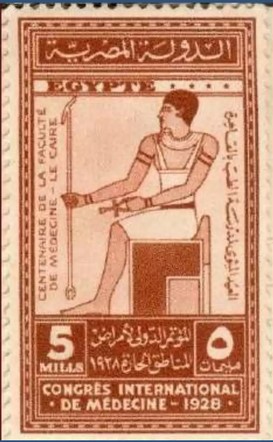
Finally, I would like to add an Egyptian stamp from 1928, on which Imhotep is honored as the god of medicine.

Imuthes 1.jpg
Open Imuthes 1.jpg · 43 KB

Image: Imhotep commemorated in 1928 on an Egyptian stamp

The big article about Imhotep will be ready soon.

Hail Satanas!
Hail Luciferus1
Hail Wotanas!

Power of Justice [SG]
#62

Attention all translators!
There was a mistake in Asclepius's Ritual that needs to be corrected in all translations. At the end section, one of the names is wrong: "Vibrate x3 times "Aslepios, Apollon, Apollonios, Asclepios""
It should be "Asclepios", not "Aslepios".

#63

So it was posted that these rituals will be done for 3 days. It’s the Monday after the Thursday that they were posted. Do we have any more rituals?

SkyveryflatEdited
#64

thanks HPZM for this new Gods Rituals done doing this 11-13

#65

Asclepios does not have any sigil, but would it be possible to put his picture as the focal point for vibrating runes? So that it can be displayed in the same vein of the other sigils.

#66
Karnonnos [JG] wrote:View source

Lord Raum is an incredibly powerful and mysterious deity who has aided humanity for many aeons. He was worshipped in Egypt for thousands of years as the God named Khnum, who was one of the oldest Gods of the Egyptian pantheon. The word Khnum means to ‘yoke together’ or ‘build’, paralleling the word yoga.

Technically, Khnum represents life in its purest state, the life-force prior to any kind of separation of species or matter by form. For this reason, He was regarded as pivotal to the maintenance of existence and of extreme importance. Khnum was associated with the entire animal world and all species within it by the same virtue of being the symbol of the life-force.

The Egyptians held Khnum to be the patron deity of the Nile, tied to the survival of Egypt as a civilization. His very word could decide the conditions for agriculture where flooding could produce rich deposits of silt and clay for year-long farming or lead to depletion. As we now know via evolutionary theory, water is where all life begins. Khnum’s most prominent temples were located on islands dedicated to His worship, such as Elephantine, near Syene, and Esna, near Thebes.

Khnum’s power was invoked by rulers for protection of their lives. The name of the Pharaoh who constructed the Great Pyramid of Giza, Khufu, means ‘Khnum is my protector.’ In Egyptian art, Pharaohs are often depicted alongside Him when asking for intercession in protective matters and functions. When the Romans conquered Egypt, the Roman emperors, beginning with Tiberius, used the imagery of this deity for good luck and to symbolize their power. Although Khnum is an extremely ancient deity, his presence remained varied, prolific, and widespread even during the Roman rule of Egypt.

Attachment 4318

Domitian with Khnum. The inscription of this scene typically reads, “The son of Re (Domitian Augustus), beloved of Khnum-Re, Lord of Esna.”

The worshippers of Khnum often congregated together to chant. For women wishing to conceive, there were rites held at the Temple of Elephantine as Khnum was petitioned to allow them to create new life.

SYMBOLS OF RAUM

Khnum is portrayed with the head of a ram, a very important symbol connecting into life and nature in its purest guise. The Germanic word ‘ram’ (of supposedly unknown origin) and Raum are connected in meaning.

To put this in simpler terms, the struggle and competition of rams is symbolic of the necessity of fighting to survive and dominate. The ram always serves as a symbol of spring from which life emerges from the deep freeze of winter. Visually, the ram’s horns symbolize the beginning of life, starting from nothing and becoming more complex and varied with evolution and development. Horns of the ram allude to many other processes of creation—ovaries, for example, have this type of shape. The Fibonacci sequence of the series of numbers where each number is the sum of the two preceding numbers is also represented in the horns:

Attachment 4319

More often, Khnum was represented with a circle on top of horizontal horns (sometimes with dual serpents attached), showing His connection to continuity and regeneration but hinting at the symbolism of eternal life through raising the serpent in the Sushumna channel.

As the bearer of the Ankh, Khnum is heavily associated with this symbol and its life-sustaining powers and the 'Ba' of the soul:

Attachment 4320

A very important aspect of this imagery is His fashioning humans from clay on the potter’s wheel and breathing life into them, as this emphasizes the significance of the raw life-force in sustaining the process of reincarnation and the furtherance of higher nature.

Khnum is depicted in ancient Egyptian reliefs within a circle, surrounded by all species, beings, and Gods, as seen in this relief at the Temple of Esna:

Attachment 4321

The word ‘room’ is also connected to the vastness of what Raum rules over, originally meaning ‘space’ or ‘vastness’ in Old English. Symbolic of this vastness is the account that Thor’s chariot is pulled by two rams, while Mangal (the planet Mars) rides a ram in Hinduism.

Raum is related to the ancient Greek mythological ram named Chrysomallos. A winged ram, sired by Poseidon, flew across the sea, rescuing the boy Phrixus and providing him with the Golden Fleece that Phrixus hung in the grove of Ares. Thereafter, the ram returned to the Gods, being sacrificed to become the constellation of Aries. The connection of Aries as being ‘the spark of life’ and Khnum is deeply rooted; He was also associated with Aries by the Egyptians themselves in the Dendera temple complex.

The ram’s horns are also represented in the glyph of Mercury, and the connection of the ram-bearing Hermes (Kriophoros) to Raum is part of this symbolism. Hermes (Thoth) wields the symbol of raw life to ward off disease and decay. This imagery was often deployed in communities of antiquity before plagues could occur.

RAUM AND THE ENEMY

Much of the symbolism of Christianity in using the ram and lambs was stolen and repackaged into the so-called ‘Lamb of God’, Agnus Dei. This false concept was written into the Bible to be the defender of the Davidic ‘house’ of the Hebrew kings, usurping Raum’s function as a protector of rulers.

Attachment 4322

The innocence and blood of the ‘Lamb of God’, cross-referenced with the Nazarene with its so-called moral characteristics in the Book of Revelations, actually refers to the virgin life-force that Raum’s domain represents. Raum is also known as an exceptionally friendly deity to humanity, and this is one of the reasons Raum was so beloved in Egypt. Once again, this sinister imposter was written on top of an elaborate process and grotesquely literalized to create a fictitious being to worship.

Endless thieving of Hermes Kriophoros was employed to represent early depictions of the Nazarene:

Attachment 4323

By the time of the dark ages, Raum was pushed into the enemy grimoires and represented as a monstrous entity taking the form of a black crow. He is said to know past, present, and future as a coy rewriting of His maintenance of life and to be a destroyer of cities in tandem with His abilities to cause destruction in military terms.

The era of this slander is now coming to an end. The sonorous chants for Lord Raum’s intercession and maintenance of everflowing life begin anew in the Heavenly Assembly of the Temple of Zeus. We are blessed to enlist the help of One so powerful and gracious among our ranks!

REFERENCES

UCLA Encyclopedia of Egyptology, Jochen Hallof

Les fêtes religieuses d'esna aux derniers siècles du paganisme (Esna V), Serge Saunderon

(Special thanks and credit to [JG] Power of Justice for assistance with editing)

Excellent job with these articles! Thank you!

Henu the GreatActive Helper
#68
SatanCrew wrote:View source

So it was posted that these rituals will be done for 3 days. It’s the Monday after the Thursday that they were posted. Do we have any more rituals?

Ad a group schedule yes. But all of these God rituals can be done as an individual, or as a group whenever people want to. Well, almost. Sometimes there are other schedules, but you get the idea.

#69
Power of Justice [JG] wrote:View source

Attention all translators!
There was a mistake in Asclepius's Ritual that needs to be corrected in all translations. At the end section, one of the names is wrong: "Vibrate x3 times "Aslepios, Apollon, Apollonios, Asclepios""
It should be "Asclepios", not "Aslepios".

If we find other typos who shall we inform? I occasionally run across anomalies.

Power of Justice [SG]
#70
The Raven wrote:View source

If we find other typos who shall we inform? I occasionally run across anomalies.

DM me or post in the editorial check thread.

#71

Great news.

I'm still working with Valefor. Is OK if I combine both Gods?

I'm also doing Balaam ritual before sleeping.

I have to say that I'm pretty new to rituals and I enjoyed doing this ritual a lot.

HAIL ZEUS!
Hail Valefor!

#72
redfox666 wrote:View source

...

Yes, you can do that. But give priority to the schedule when it is published. After the schedule you can do other rituals if you want.

AristocraticDragon666Active Helper
#73
Hp. Zevios Metathronos wrote:View source

Greetings everyone,

After our recent small schedule, below you will find the new Rituals. After the conclusion of the days of the Schedule, these are to be done for 3 consecutive days. Asclepius is a new God that is introduced to the Temple of Zeus [God of Healing, he became a God] and is a well known God for his healing capacities and amazing abilities.

Raum is known as Khnum and his powers are related to the creation, maintenance and source of all life in existence. Both the Rituals are going to be amazing, so do participate. Below are the links to the Rituals.

More things upcoming soon:

Raum Power Ritual: https://tozrituals.org/ritual/demon/khnum-power-ritual.htmlExternal ↗
Asclepius Power Ritual: https://tozrituals.org/ritual/demon/asclepius-power-ritual.htmlExternal ↗

-High Priest Zevios Metathronos

Asclepius Power Ritual simply Magnificent 😍😍😍

I will try to do this ritual every day, regardless of the schedule.

After this ritual, my overall health has improved, I feel healthier, stronger, more resilient and stress-resistant, and my sleep has improved.

Novice Priest Karnonnos
#74

Regarding Imhotep, I was told by the Gods while writing NOT to conflate Him as being Asclepius. The identification of the two was due to cultural factors between the Greeks and Egyptians so either could understand, not them being the exact same being. There are a number of these cases that can lead people astray if they take things literally, so beware of this.

#75
Hp. Zevios Metathronos wrote:

When Asclepius was incarnated, he was already on a super high level. He incarnated only to help. And then he continued from there.

Can I disincarnate and ascend to the duat as soon as I am ready?

WotanwarriorActive Translator
#76
Karnonnos [JG] wrote:View source

Regarding Imhotep, I was told by the Gods while writing NOT to conflate Him as being Asclepius. The identification of the two was due to cultural factors between the Greeks and Egyptians so either could understand, not them being the exact same being. There are a number of these cases that can lead people astray if they take things literally, so beware of this.

There are more historical errors of this type that have been perpetuated for many centuries until today, for example it also say that the Pharaoh Amenhotep III is the same person as the legendary Hero Memnon and in reality this is not true.

#77

Where has Pythia written about hecate and khephru ?in the list of gods and goddesses is there any God by name hecate and khephru ??Can anyone send me the link of these gods description?

Seuterdaotmssaa
#78
Sundara wrote:

Sa spus deja că Asclepius este Asmodeus, iar din informațiile disponibile - soție sau tutore, parteneră, un termen important - este tot Astarte. Așadar, dacă Asclepius ajută la prezicerea acestui lucru și menține informațiile relevante și intacte - ar avea sens ca acesta să fie tot Asmodeus.

Oricine este liber să corecteze sau să comenteze dacă greșesc sau am înțeles greși

Sundara wrote:

Sa spus deja că Asclepius este Asmodeus, iar din informațiile disponibile - soție sau tutore, parteneră, un termen important - este tot Astarte. Așadar, dacă Asclepius ajuta la prezicerea acestui lucru și menține informațiile relevante și intacte - ar avea sens ca acesta să fie tot Asmodeus.

Oricine este liber să corecteze sau să comenteze dacă greșesc sau am înțeles greșit.

UEMP

Sundara wrote:

S-a spus deja că Asclepius este Asmodeus, iar din informațiile disponibile - soție sau tutore, parteneră, un termen important - este tot Astarte. Așadar, dacă Asclepius ajută la prezicerea acestui lucru și menține informațiile relevante și intacte - ar avea sens ca acesta să fie tot Asmodeus.

Oricine este liber să corecteze sau să comenteze dacă greșesc sau am înțeles greșit.

Eu susțin ce spui. Garantat sunt împreună!